


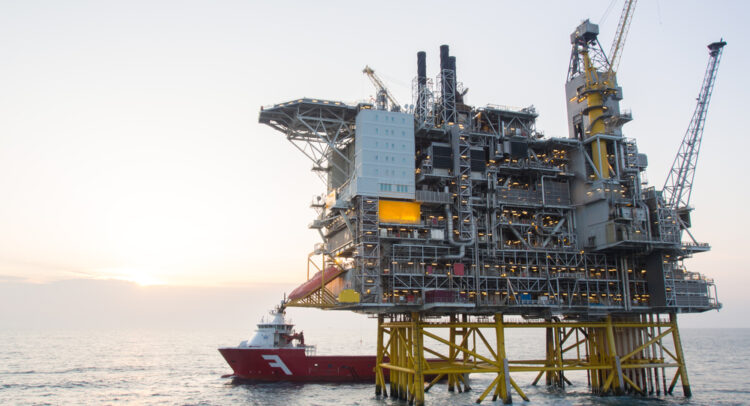
Seadrill Limited ((SDRL)) has held its Q4 earnings call. Read on for the main highlights of the call.
Claim 30% Off TipRanks
- Unlock hedge fund-level data and powerful investing tools for smarter, sharper decisions
- Discover top-performing stock ideas and upgrade to a portfolio of market leaders with Smart Investor Picks
Seadrill Limited’s latest earnings call struck a cautiously optimistic tone, balancing near‑term headwinds with a convincing case for stronger earnings and cash flow from 2026 onward. Management leaned on record safety, solid EBITDA outperformance and a growing backlog to argue that repriced contracts and lower capital spending will unlock material value despite a tough 2025 market.
Record Safety and Operational Excellence
Seadrill reported the best safety performance in its history, with a total recordable incident rate 50% better than the IADC offshore benchmark. Operationally, standout achievements included West Neptune’s record six‑zone completion in 11 days and West Tellus’ 400 consecutive days of subsea BOP deployment, underlining high fleet reliability.
Full‑Year 2025 Financial Results — EBITDA Beat
Adjusted EBITDA for 2025 reached $353 million, ahead of the midpoint of prior guidance and supported by a solid fourth quarter EBITDA of $88 million. Q4 operating revenues were $362 million, essentially flat sequentially, as slightly lower contract drilling revenues were offset by higher reimbursables and stable SG&A.
Backlog Growth and Recent Contract Awards
The company expanded its contracted backlog by roughly $0.5 billion to about $2.5 billion, a gain of around 25% that materially improves revenue visibility. Key wins included a 14‑month West Capella award worth about $152 million, a four‑month West Neptune extension, and options exercised on Sonangol Quenguela and West Saturn into 2027.
2026 Guidance and Clear Path to Cash Flow Inflection
For 2026, Seadrill guides to $1.40–$1.45 billion of operating revenue and $350–$400 million of EBITDA, with about 90% of midpoint revenue already covered by backlog. CapEx and long‑term maintenance are set to fall to $200–$240 million, and management expects a step‑up from Q2 leading to a pronounced cash‑flow inflection in the second half of 2026 and into 2027.
Fleet Repricing and Earnings Leverage
Management highlighted significant earnings leverage from repricing legacy drillships onto richer contracts, particularly West Jupiter and West Tellus. Both are being rolled onto three‑year deals at day rates roughly $200,000 higher than prior terms, which should meaningfully boost EBITDA and cash generation as these contracts ramp through 2026–2027.
Positive Industry Tailwinds and Market Signals
The macro backdrop appeared supportive, with the IEA projecting continued oil and gas demand growth and Westwood expecting floater utilization to climb to the mid‑90s by 2027. Subsea activity indicators are trending up, and although Seadrill’s share price has surged more than 50% in three months, management believes the stock still trades at a discount to peers.
Q4 Cash Outflows and Legal Payment
Fourth quarter cash usage totaled $63 million, driven chiefly by a $43 million legal outflow tied to a joint‑venture dispute and front‑loaded spending on maintenance and rig preparation. Seadrill closed the year with $365 million in cash and $524 million in total liquidity against $625 million of debt maturing steadily through 2030, leaving the balance sheet manageable.
Challenging and Competitive 2025 Market
Management characterized 2025 as a difficult year for contracting, with competitive tendering and pockets of geographic softness weighing on visibility. Day rates for top‑tier rigs are holding in the low $400,000s per day but with uncertainty, and the company cautioned that 2026 EBITDA will start softer in Q1 as rigs undergo contract preparations.
Stacked Assets and High Reactivation Costs
Several stacked or lower‑spec units, including Aquarius, Phoenix and Eclipse, remain idle and would require heavy capital outlays to return to work, limiting near‑term earnings contribution. Management signaled a disciplined stance, insisting on either customer cost sharing or highly attractive contracts before authorizing costly reactivations, especially for low‑spec units like West Eclipse.
Availability and Timing Risk for Key Rigs
The call acknowledged execution risk around several drillships that will roll off contracts and seek new work in 2026, including West Neptune, West Vela and West Carina. While some have coverage into the first half, the need to secure fresh awards for multiple units introduces timing risk to revenue and could create competitive pressure as rigs become available together.
Legacy Legal and JV Exposure
The recent $43 million unfavorable legal judgment related to a joint venture underscored that legacy and JV‑related risks remain a drag on cash. Though not seen as structural to the business, these exposures add an element of unpredictability to near‑term liquidity planning, reinforcing management’s focus on maintaining a solid cash buffer.
Forward‑Looking Guidance and Capital Allocation Outlook
Looking ahead, Seadrill’s message was that 2026–2027 should mark a step‑change in profitability and free cash flow as repriced contracts, particularly for West Jupiter and West Tellus, take full effect. With $2.5 billion of backlog, high revenue coverage for 2026 and lower CapEx, management sees a clear path to stronger cash generation and potential flexibility for future capital returns if market conditions hold.
Seadrill’s earnings call painted a picture of a contractor navigating a choppy 2025 while methodically setting up for a stronger upcycle. Investors will need to look through near‑term cash outflows, legal noise and contracting risk, but the combination of record safety, solid EBITDA, rising backlog and repriced rigs offers a compelling medium‑term story if offshore fundamentals continue to tighten.