



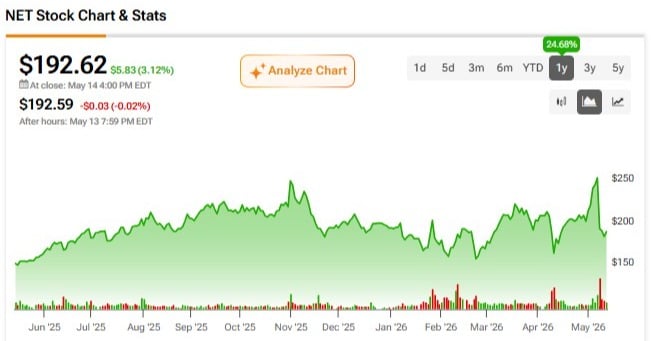
Cloudflare (NET) reported its strongest quarterly revenue to date on May 7. In my opinion, its positioning inside the artificial intelligence (AI) infrastructure buildout is as compelling as ever, particularly as demand grows for low-latency computing, cybersecurity, and distributed cloud services. However, the cloud connectivity and security company’s earnings profile still has not fully caught up to the ambition of that story.
Claim 55% Off TipRanks
- Unlock hedge fund-level data and powerful investing tools for smarter, sharper decisions
- Discover top-performing stock ideas and upgrade to a portfolio of market leaders with Smart Investor Picks
Cloudflare’s financial profile reflects a business in heavy reinvestment mode. As such, the gap between the strategic narrative and the earnings trajectory is wide enough that I’m only cautiously bullish about its prospects. What I’m waiting for is how quickly the business that operates one of the world’s largest and most distributed edge networks can convert its AI opportunity into durable profitability.
The Business
Cloudflare largely operates across four broad product areas: Application Services, which covers its content delivery network and Distributed Denial-of-Service (DDoS) protection; Zero Trust and security, which competes with names like Zscaler (ZS) and Palo Alto Networks (PANW); Network Services, which handles connectivity and routing infrastructure; and Developer Services.
The main anchor for that last segment is the company’s Workers platform, and I believe that it is the part of the business that matters most to the AI thesis. The platform is a serverless compute environment that runs at the network edge, and it is increasingly the layer on which AI agents, inference workloads, and agentic applications are being built. That positioning is the core of what Cloudflare is becoming.
AI Positioning
Cloudflare reported $639.8 million in revenue for Q1 2026, up 34% year-over-year, with most of that growth driven by the extensive expansion of its AI and agentic workloads across the network. Of course, we cannot ignore the strength in its largest customer cohorts and the accelerating adoption of the Workers developer platform.
That revenue figure beat its own guidance range of $620–$621 million by a meaningful margin. Customers spending more than $100,000 annually reached 4,416, up 25% year-over-year, and remaining performance obligations rose to $2.543 billion. Clearly, then, the enterprise demand for Cloudflare’s platform is genuinely deepening.
We can see this with the AI-specific numbers: graphics processing unit (GPU) utilization on Cloudflare’s network is running at 70%–80%, compared to single-digit percentages at the hyperscalers. That is a pretty big efficiency advantage that will only become even more important moving forward, given that AI inference workloads will soon become the dominant growth vector in cloud infrastructure.
It’s the same for its internal adoption: internal AI usage grew 600% in three months, with 97% of engineers using AI tools.
The Earnings Gap
The topline is impressive, but there is still a sizable gap between Cloudflare’s revenue growth and its bottom line. For example, its GAAP operating loss in Q1 2026 was $62 million, and on a non-GAAP basis, the company swung to a profit of $73.1 million, a substantial $135 million adjustment primarily driven by stock-based compensation. Meanwhile, the company’s free cash flow was $84 million, or about 13% of revenue.
Cloudflare doesn’t look great on an earnings front, and it is spending fairly heavily on infrastructure and stock-based compensation (SBC).
I understand the business case for higher expenditure, but that is happening as margins shrink, even with record revenue. Something has to give soon, and we might be seeing the first signs of that with the company’s agentic AI-first operating model transition. During the Q1 2026 earnings call, CEO Matthew Prince announced that Cloudflare will restructure operations soon and lay off around 20% of its current workforce.
That’s more than 1,100 employees who’ll be laid off, and the company will stomach another $140–$150 million in restructuring charges for FY2026 to make it happen. Meanwhile, management says the guidance for free cash flow won’t change, but I expect that the margins will still be depressed for the remaining three quarters of the current fiscal year. Investors pricing in a clean earnings ramp in 2026 need to account for those charges hitting hard in the next two quarters.
Margins and the Reinvestment Reality
The GAAP gross margin came in at roughly 76.1% for Q1, and that compression is largely due to a revenue mix shift toward lower-margin developer products and a reallocation of network costs. The Workers platform and AI inference workloads will continue to grow as a share of Cloudflare’s revenue, and the mix carries structurally lower margins than its legacy application services business. It is something to remember, especially because the company’s path to meaningful operating leverage requires scale in those products, not just growth.
For full-year 2026, Cloudflare guides revenue of $2,805–$2,813 million and non-GAAP earnings per share (EPS) of $1.19–$1.20. The Q2 guidance of $664–$665 million implies sequential growth deceleration to roughly 30% year-over-year, which disappointed investors expecting the Q1 beat to translate into raised full-year targets. Instead, the company held guidance flat. I don’t read that as a red flag, but I understand why the market does.
Valuation and Peers
Cloudflare trades at a significant premium at a forward P/E of roughly 80x compared to the IT sector median of 26.5x. Now, I think a premium is partially justified by the platform’s strategic positioning, but it is hard to justify its current valuation relative to its peers, especially given the earnings gap. GAAP ROE stands at -28.4% and ROIC at -5.2%, both reflecting the reality that the business is not yet earning above its cost of capital on a reported basis. For a stock trading at such premium multiples, the implied assumption is that it will, and soon.
I can understand the bullishness, especially on a market front. Cloudflare’s total addressable market is projected to grow from $181 billion in 2025 to $231 billion by 2028, spanning Zero Trust, network services, application services, and developer platforms. If the AI inference and agentic computing opportunity further expands TAM, the long-term setup is genuinely attractive. The question is what investors are asked to pay today to access it.
Is NET a Buy, Sell, or Hold According to Wall Street?
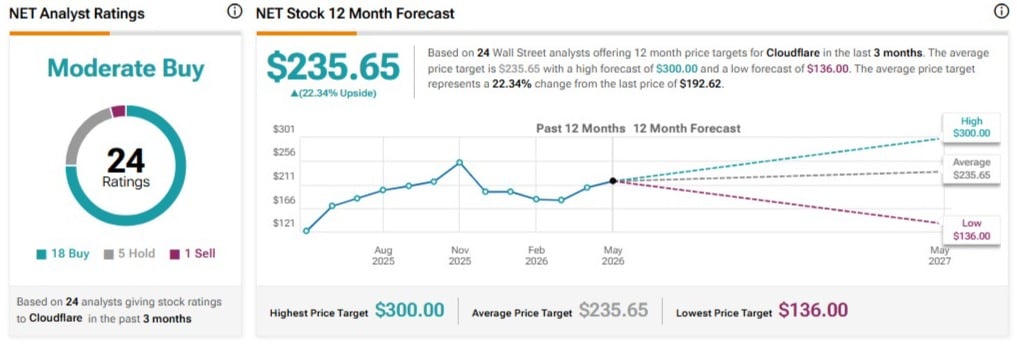
Turning to Wall Street, Cloudflare has a Moderate Buy consensus rating based on 18 Buys, five Holds, and one Sell assigned in the last three months. At $235.65, the average NET price target implies 22.34% upside from today’s price.
Bottom Line
Cloudflare is building something genuinely important inside the AI infrastructure stack, and Q1 showed that enterprise demand for that vision is real and growing. The financial profile, though, still reflects a business that is investing ahead of its earnings trajectory, and the restructuring charges hitting Q2 and Q3 will test the market’s patience before the efficiency gains arrive.
I am cautiously bullish on NET from current levels, with conviction contingent on the restructuring executing cleanly and the free cash flow margin expanding toward 20% over the next four to six quarters.