Cerebras (CBRS) began trading publicly on Thursday at $350 per share, up from its $185 IPO price, making it one of the first major AI-focused IPOs in 2026. The company is trying to compete with AI chip giants like Nvidia (NVDA) and AMD (AMD), but its approach is very different. Instead of making smaller chips like traditional chipmakers, Cerebras builds a massive wafer-sized processor called the WSE, or wafer-scale engine, which it says is the largest commercial chip ever produced. Indeed, its big pitch is that a much larger chip can deliver faster AI training and inference in certain workloads.
Claim 55% Off TipRanks
Trade NVDA with leverageCerebras Chips Can Help Data Move Faster
This is because Cerebras chips have more room for processing power and memory, which can help data move faster than it would in systems that rely on multiple chips working together. However, this approach is also harder and more expensive to manufacture, because a major flaw in one wafer-sized chip can put the whole product at risk. In addition, University of Illinois professor Deming Chen explained that smaller chips are usually cheaper, easier to produce, and easier to scale. Still, Cerebras says it has reduced some of that risk with a fault-tolerant design that can route around flaws inside the wafer.
The company also uses SRAM, a faster but more complex and expensive type of memory than the DRAM used in many traditional systems. Because the chip is so large, Cerebras has enough space to use more of that faster memory while also shortening the distance that data needs to travel. The company says this can make AI responses up to 15 times faster than leading GPU-based systems, but Chen cautioned that Cerebras is unlikely to replace Nvidia or AMD across the board. Instead, its technology may shine in specific AI workloads while smaller chips remain more practical for most use cases.
What Is a Good Price for NVDA?
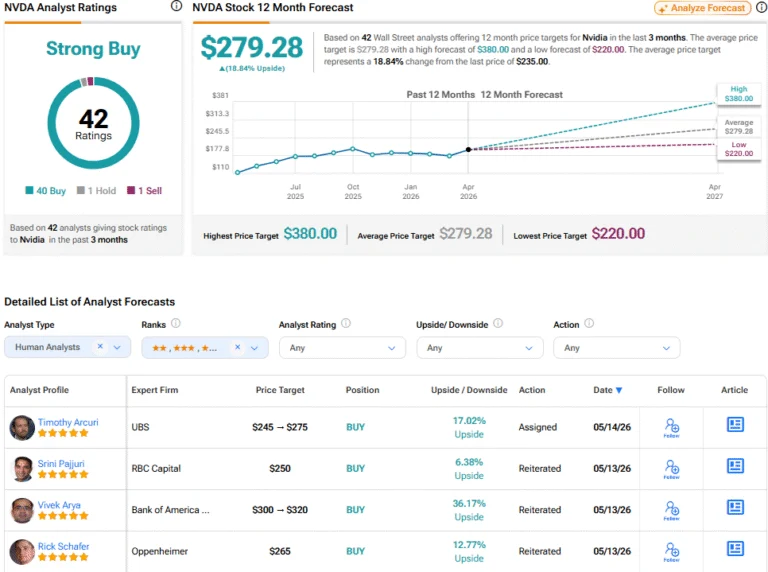
Turning to Wall Street, analysts have a Strong Buy consensus rating on Nvidia stock based on 40 Buys, one Hold, and one Sell assigned in the past three months, as indicated by the graphic below. Furthermore, the average Nvidia price target of $279.28 per share implies 18.8% upside potential.