


Broadcom (AVGO) validates the artificial intelligence (AI) infrastructure bull case with a projected path to $100 billion in AI chip revenue by 2027, as multi-year hyperscaler commitments signal that demand is structural, not cyclical. AI semiconductor revenue already surged 106% year-over-year in Fiscal Q1 2026, and with supply secured through 2028, the execution risk that typically shadows AI growth stories is materially reduced. I remain bullish on AVGO and regard any price pullback as a viable opportunity to buy into Broadcom shares.
Meet Samuel – Your Personal Investing Prophet
NVDS: built for a short position on NVDA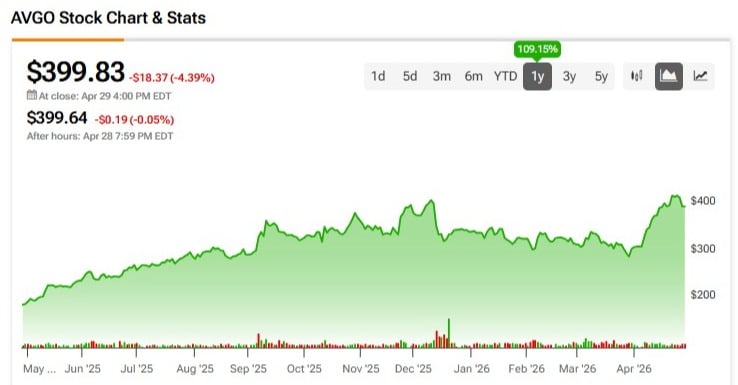
A global semiconductor and infrastructure software company headquartered in California, Broadcom operates through two segments: Semiconductor Solutions and Infrastructure Software.
Broadcom’s Hyperscaler Agreements Give Its AI Revenue Runway Further Visibility
Cloud and AI giants, such as Google-parent Alphabet (GOOGL) and Meta Platforms (META), both Broadcom customers, have been shifting from off-the-shelf graphics processing units (GPUs) to custom application-specific integrated circuits (ASICs) to optimize cost and performance at scale. Broadcom operates at two critical layers: co-designed chips and the networking fabric that connects large AI clusters.
The company has assembled multi-year, gigawatt-scale commitments that are likely to convert future AI buildouts into contracted revenue.
In early April, Broadcom secured a long-term agreement with Alphabet to develop and supply custom Tensor Processing Units (TPUs) for future TPU generations, alongside a networking supply deal covering Google’s AI rack infrastructure through 2031. That arrangement also encompasses an expanded collaboration with Anthropic, which Alphabet has been investing in. In the same period, Broadcom and Meta announced a multi-year partnership to co-develop Meta Platforms’ next-generation custom AI accelerators.
These agreements build on already strong execution. In Fiscal Q1 2026, Broadcom’s AI semiconductor revenue rose 106% year-over-year to $8.4 billion. Management now projects AI semiconductor revenue to exceed $100 billion by 2027, supported by secured component supply through 2028. Reliance on a handful of hyperscalers as main customers is a genuine risk, but agreements of this length and scale mean Broadcom is not guessing at future demand.
Record Profitability and Cash Flow Underwrite the Bull Case
Broadcom’s financial profile is structurally strong as well. Fiscal Q1 2026 free cash flow reached $8 billion, or 41% of revenue, while trailing twelve-month free cash flow stands at approximately $28.9 billion. A semiconductor gross margin of approximately 68% reflects the pricing power embedded in hyperscaler infrastructure, which is difficult to substitute or renegotiate.
The near-term outlook sustains that momentum. Fiscal Q2 2026 consolidated revenue is guided at approximately $22 billion, up 47% year-over-year, with gross margin roughly flat sequentially at approximately 77% and earnings before interest, taxes, depreciation, and amortization (EBITDA) near 68% of revenue.
Broadcom also returned $10.9 billion to shareholders in Fiscal Q1 through dividends and buybacks, and the board authorized an additional $10 billion repurchase program. In other words, management is confident in the sustained cash generation trajectory.
Finally, Broadcom’s growth-adjusted picture makes the bull case more explicit. At approximately 31x forward earnings, AVGO does not look cheap at first glance. Yet its PEG ratio of 0.26 compares favorably with 0.49 for Advanced Micro Devices (AMD) and 0.57 for Nvidia (NVDA), implying a lower price-to-expected-growth ratio. Broadcom’s current multiple does not fully reflect the revenue forecast of over $100 billion for Fiscal 2027. The stock also pays a quarterly dividend of $0.65 per share, adding a modest 0.69% yield to the total return profile.
Three ETFs Offer a Diversified Path to Broadcom’s AI Thesis
For investors seeking exposure to Broadcom through an exchange-traded fund (ETF), the VanEck Semiconductor ETF (SMH) offers the most direct route, with Broadcom among its largest holdings. SMH appeals to investors seeking broad exposure to the semiconductor supply chain while retaining Broadcom as the anchor position.
For a wider technology mandate, the Technology Select Sector SPDR Fund (XLK) holds Broadcom within a diversified portfolio spanning mega-cap software, hardware, and services. XLK fits investors who are broadly constructive on AI infrastructure but prefer to limit semiconductor-specific volatility while maintaining a meaningful Broadcom weighting.
Finally, the Invesco QQQ Trust (QQQ) tracks the Nasdaq-100 Index and holds Broadcom alongside the largest technology and growth companies in the U.S. market. QQQ suits investors who want some Broadcom exposure within a broader portfolio of mega-cap technology leaders, without focusing solely on the semiconductor sector.
Is AVGO Stock a Buy, Sell, or Hold?
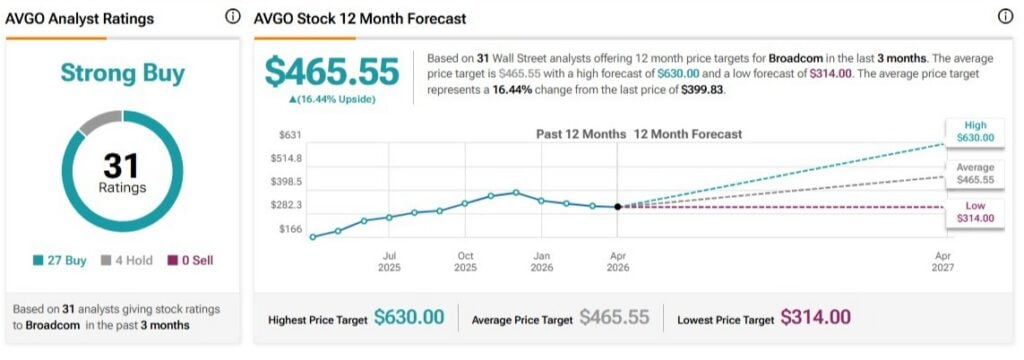
Broadcom currently carries a Strong Buy consensus rating, based on 31 Wall Street analysts covering the stock over the past three months, consisting of 27 Buys, four Holds, and no Sells. The average 12-month price target for AVGO is $465.55, implying upside of approximately 16.5% from the current share price of $399.83.
Conclusion
Broadcom has carved out a formidable position in the AI cycle: a franchise with multi-year revenue visibility. By owning both the custom silicon and the networking layer, the company is embedded in hyperscaler infrastructure spending that cannot easily be rerouted. With a PEG of 0.26, approximately $28.9 billion in trailing free cash flow, and a Fiscal 2027 revenue trajectory of more than $100 billion underwritten by named agreements with Alphabet and Meta Platforms, Broadcom reflects a compounding business aligned with a durable multi-year investment cycle. I remain bullish on AVGO.