



Boeing (BA) may still have room to run as its recovery shifts from disruption to normalization. After a strong rebound late last year, the stock has pulled back roughly 25% from its January highs, creating an attractive entry point. A record backlog, improving production, and rising free cash flow support further upside, keeping me bullish.
Meet Samuel – Your Personal Investing Prophet
- Start a conversation with TipRanks’ trusted, data-backed investment intelligence
- Ask Samuel about stocks, your portfolio, or the market and get instant, personalized insights in seconds
Boeing is one of the most important aerospace manufacturers, spanning commercial aircraft, defense, space, and aviation services. Its story is no longer just about survival or damage control. Instead, it is increasingly about a company moving toward more stable operations and better execution, supported by multiple long-duration growth drivers beyond commercial jets.

Boeing Is Moving from Crisis Management to Rebuild Mode
The most important change in the Boeing story is that the company appears to be exiting triage and entering a more durable rebuilding phase. That distinction matters. For years, the investment case was dominated by safety issues, regulatory pressure, supply chain constraints, labor disruption, and weak cash generation. Those risks have not disappeared, but the center of gravity is shifting.
Recent results reinforced that transition. Q4 2025 revenue rose 57% year-over-year to $23.95 billion, while total company backlog reached a record $682 billion. Commercial airplanes backlog alone stood at more than 6,100 aircraft valued at roughly $567 billion. That level of demand gives Boeing something it has badly needed: multi-year revenue visibility.
The market is still treating Boeing like a story that must prove every quarter it can avoid the next setback. I think that framing is becoming stale. The better question now is how much earnings and cash flow can recover if Boeing simply executes at a steadier, more predictable level.
Commercial Aerospace Still Provides a Long Runway
Boeing’s largest long-term opportunity remains commercial aerospace, and the structural backdrop is supportive. Global air travel continues to expand, and Boeing’s own long-range market outlook points to demand for nearly 44,000 new aircraft through the early 2040s. More than half of that demand is expected to come from growth rather than replacement, which is critical because it implies a larger future fleet rather than just fleet renewal.
That supports long-duration demand across Boeing’s core programs. The 737 remains central to single-aisle demand, while the 787 and 777X should benefit from widebody replacement and long-haul route expansion. The widebody opportunity matters more than many investors appreciate because it can drive a better mix, higher dollar content, and stronger aftermarket revenue over time.
Yes, near-term production is still imperfect. Boeing recently disclosed rework on some 737 MAX aircraft because of wire scratches, and first-quarter deliveries may be somewhat slower as a result. Yet the broader industry backdrop remains one of scarcity, not oversupply. Airlines, lessors, and manufacturers are all operating in a constrained market, where delivery slots for new narrowbodies are tight well into the next decade. In that kind of environment, Boeing does not need perfection to create value. It needs credible, incremental execution.
The Free Cash Flow Story Is Becoming More Real
If the bull case on Boeing is going to work, free cash flow has to become tangible. That is exactly why I think the setup remains attractive. The market is starting to believe Boeing can generate cash again, but I do not think it fully appreciates the extent of its operating leverage if production continues to normalize.
Management has effectively level-set 2026 as a transition year, with free cash flow likely in the $1 billion to $3 billion range. On the surface, this may not look exciting. However, the figure is weighed down by several unusual items, including higher capital spending, 777X investment, Spirit AeroSystems integration effects, debt obligations, and other temporary cash uses. The more important point is that Boeing has outlined a path from this transitional phase toward much stronger normalized cash generation.
Some analysts now model roughly $2.5 billion in free cash flow for 2026 and $7 billion for 2027. Even if those numbers prove a bit optimistic, the direction of travel is what matters. Boeing is moving from cash consumption to cash generation, and that shift should eventually allow it to reduce debt, strengthen the balance sheet, and reinvest more confidently in production and future platforms.
Defense and Services Add More Than Just Stability
Many investors still view Boeing as a story of commercial aircraft recovery. That misses an important part of the picture. Defense, space, and services are meaningful businesses in their own right, and they make the long-term investment case more durable.
Boeing’s Defense, Space & Security segment exited 2025 with a record backlog of about $85 billion. Rising geopolitical tension, higher U.S. and allied defense spending, and growing investment in national-security space programs should support this segment well into the 2030s. That does not mean defense will suddenly become Boeing’s primary growth engine, but it does provide a valuable counterweight to the cyclicality of commercial aerospace.
Then there is Boeing Global Services, which may be the most underappreciated part of the story. Services revenue is more recurring, more resilient, and generally has a higher margin than aircraft manufacturing. Boeing estimates the industry services market at more than $4 trillion over 20 years, spanning maintenance, parts, modifications, training, and digital solutions. As Boeing delivers more aircraft and the installed fleet grows, the lifetime monetization opportunity expands.
Wall Street’s View
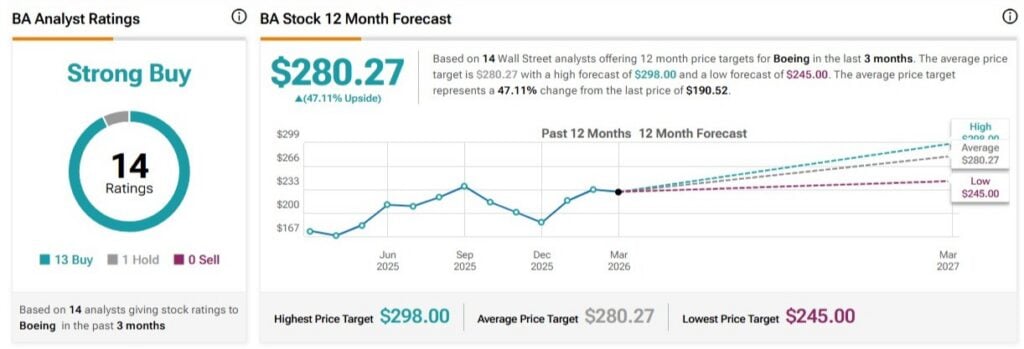
According to TipRanks, Boeing has a Strong Buy consensus rating, with 13 Buy, one Hold, and no Sell ratings. The average 12-month price target is $280.27, implying roughly 47% upside from the recent price of $190.52.
Conclusion
I am bullish on Boeing because the recovery story has evolved into something broader and more durable. Commercial aerospace demand remains strong, the backlog is enormous, free cash flow is rebuilding, and defense plus services add important layers of resilience.
The stock’s roughly 25% pullback from January highs looks like an opportunity to me, not a reason to step aside. Boeing still has execution work ahead, but it no longer needs a perfect story to justify upside. It needs steady progress, and that is exactly what the company appears increasingly capable of delivering.