


ASML Holding’s (ASML) softer Q2 outlook doesn’t change the bigger artificial intelligence (AI) picture, in my view. ASML is one of the most important companies in the semiconductor supply chain, supplying the lithography tools chipmakers need to manufacture advanced chips.
Meet Samuel – Your Personal Investing Prophet
- Start a conversation with TipRanks’ trusted, data-backed investment intelligence
- Ask Samuel about stocks, your portfolio, or the market and get instant, personalized insights in seconds
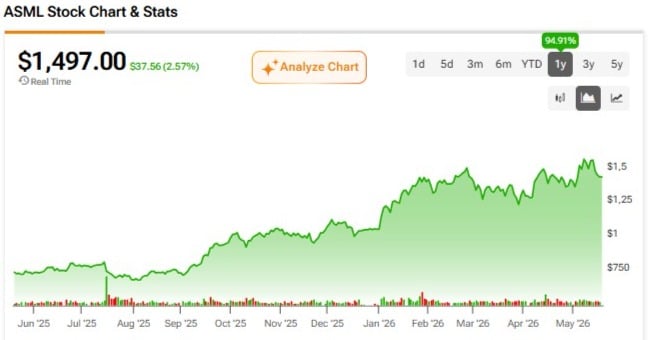
The stock has nearly doubled over the past 12 months, rising about 97%, so expectations are clearly high. Still, I remain bullish because ASML’s extreme ultraviolet (EUV) monopoly, AI-driven memory demand, and improving 2027 outlook outweigh the near-term noise.
Q2 Was Light, but 2026 Looks Better
ASML’s first-quarter results were strong. Revenue came in at €8.8 billion, ahead of consensus at €8.6 billion, while earnings per share (EPS) of €7.15 beat expectations of €6.57. Gross margin was also solid at 53%, helped by stronger services revenue. The problem was guidance. Management guided Q2 revenue to about €8.7 billion at the midpoint, below the consensus of roughly €9.1 billion. That is not ideal, especially after such a strong stock run.
However, the bigger message was more positive: ASML raised its Fiscal 2026 revenue outlook to €36 billion to €40 billion, up from €34 billion to €39 billion, reflecting stronger AI-related demand in memory and advanced logic. That matters more to me than one softer quarter.
I also think investors are underestimating how cyclical the timing of these orders can be. ASML is not selling low-cost commodity products. These are multi-hundred-million-dollar systems tied to fab construction schedules, clean-room readiness, and customer capacity planning. Quarterly volatility is normal. What matters is the multi-year trajectory, and that still looks very strong.
EUV Demand Remains the Core Bull Case
The biggest reason I like ASML is simple: EUV demand is stronger than supply. EUV revenue rose 14% quarter-over-quarter to €4.1 billion, with 16 tools shipped. Management now expects at least 60 low-NA EUV systems in 2026 and says 80-plus systems are achievable in 2027.
That is the real story. AI infrastructure is driving demand for advanced DRAM, HBM, and leading-edge logic. Those chips require more lithography intensity, not less. There is a supply constraint for memory customers, and advanced logic demand should improve in the second half. ASML is not just another semiconductor equipment company. It is the gatekeeper for the world’s most advanced chip manufacturing. That monopoly is extremely hard to replicate.
Importantly, the moat is not only technological — it is also operational. Even if a competitor eventually develops something close to EUV capability, replicating ASML’s ecosystem, supply chain, and reliability, along with decades of customer integration, would take years. That is why I still see ASML’s monopoly as sustainable for the foreseeable future.
China’s Weakness Looks Manageable
China remains a concern, but I think the risk is increasingly understood. China’s share of system sales fell to 19%, down more than 50% quarter-over-quarter and broadly in line with management’s expectation for around 20% in 2026.
Yes, deep ultraviolet (DUV) sales were weak because of China. However, non-China demand appears healthy, and management now expects non-EUV revenue to grow in 2026 rather than remain flat. In other words, AI-driven demand from memory and advanced logic should more than offset China’s normalization.
I also think the market is becoming more comfortable with the idea that ASML can continue to grow strongly even with lower exposure to China. South Korea’s memory demand remains extremely strong, U.S. semiconductor investments continue to ramp, and Japan is increasing spending on advanced logic manufacturing.
Services Add Stability
One underappreciated positive is ASML’s services business. Services revenue rose 18% quarter-over-quarter to around €2.3 billion, and management expects double-digit year-over-year growth in Q2.
This matters because customers are trying to squeeze more output from existing fabs amid clean-room constraints. ASML benefits not only when customers buy new tools, but also when they optimize installed tools. That gives the business a more durable earnings base than investors sometimes appreciate.
Over time, I think the services mix could also help support margins, especially as the installed base of advanced EUV systems grows globally.
Valuation Is Premium, but the Stock Deserves It
ASML is not cheap. The stock trades at about 51x trailing P/E compared with a broader tech sector median of roughly 33x and around 46x free cash flow, versus the sector median near 18x.
I know that looks stretched, especially after the stock’s huge rally. However, I think a premium is justified. ASML has a near-monopoly in EUV, rising visibility into 2027 growth, strong services economics, and direct exposure to AI chip capacity expansion.
Frankly, I would be more worried if the stock were trading cheaply. Premium companies with structural advantages rarely stay discounted for long. In ASML’s case, the valuation reflects scarcity value as much as near-term earnings.
Wall Street’s View
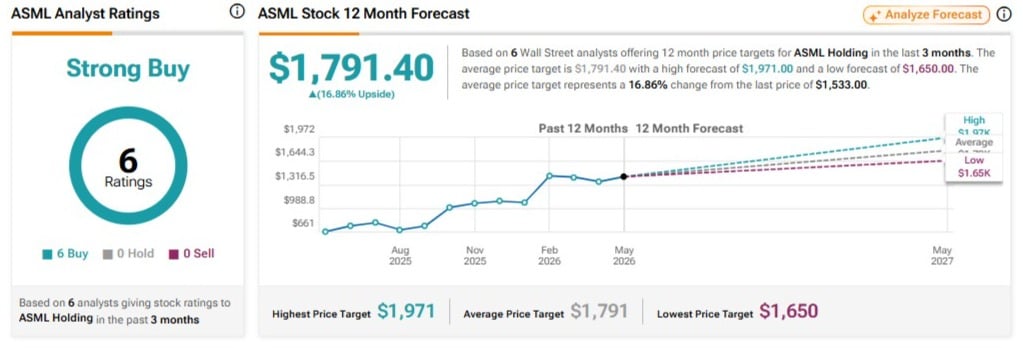
According to TipRanks, ASML has a Strong Buy consensus rating, with six Buy, no Hold, and no Sell ratings. Based on six Wall Street analysts, the average price target is $1,791.40, implying 16.86% upside from the recent price of $1,533.
Conclusion
ASML’s Q2 outlook was softer than investors wanted, but I do not see it as thesis-changing. The company beat in Q1, raised its full-year revenue outlook, and continues to see EUV demand outpace supply.
The stock is expensive, and after a nearly 97% one-year gain, pullbacks would not surprise me. However, the AI-driven lithography cycle still looks powerful, China risk appears more manageable, and 2027 could be a stronger year than the market currently models.
To me, this still looks like a company benefiting from one of the strongest secular trends in tech, and one that competitors cannot easily replicate. I remain bullish on ASML.