Investors might be ruing the fact April is now sadly behind us, as it was a fantastic month for the stock market.
Claim 55% Off TipRanks
- Unlock hedge fund-level data and powerful investing tools for smarter, sharper decisions
- Discover top-performing stock ideas and upgrade to a portfolio of market leaders with Smart Investor Picks
The S&P 500 climbed 10%, marking its best monthly performance since November 2020. The Nasdaq Composite performed even better, rising more than 14% and posting its strongest month since April 2020.
But as has often been the case in recent times, chip stocks led the way. The PHLX Semiconductor Index jumped by more than 40% in the month (as has the iShares Semiconductor ETF). That made it its strongest monthly gain since February 2000, continuing a powerful multi-month run that has been closely tied to ongoing AI-related momentum. The index also recorded an 18-day winning streak and advanced for 13 consecutive sessions into new record highs, underscoring just how strong momentum has been.
Individual chip stocks naturally saw similarly extreme moves. Intel (INTC) delivered its strongest monthly performance on record, extending its breakout above long-standing highs last seen in the dot-com era following its Q1 earnings. AMD (AMD) recorded its strongest month since January 2001, while Micron (MU) and Texas Instruments (TXN) both posted their strongest monthly gains since February 2000.
Meanwhile, Nvidia (NVDA) saw its market cap rise above the $5 trillion level during the week and Arm surged more than 40%, its strongest monthly gain in around two years. Even AI laggard Qualcomm (QCOM) surged, adding 41% over the month.
The rally has been fueled by continued investor enthusiasm around AI infrastructure buildout. That said, there is also a fundamental backdrop supporting the move, with global spend on semiconductors projected to reach around $1.3 trillion in 2026, representing an estimated 64% increase year-over-year, according to Gartner.
That said, the strength of the move has pushed both the index and many of its constituent stocks into stretched technical territory. At this point, it would be normal to expect a short-term pullback as the market digests recent gains, or either a period of consolidation.
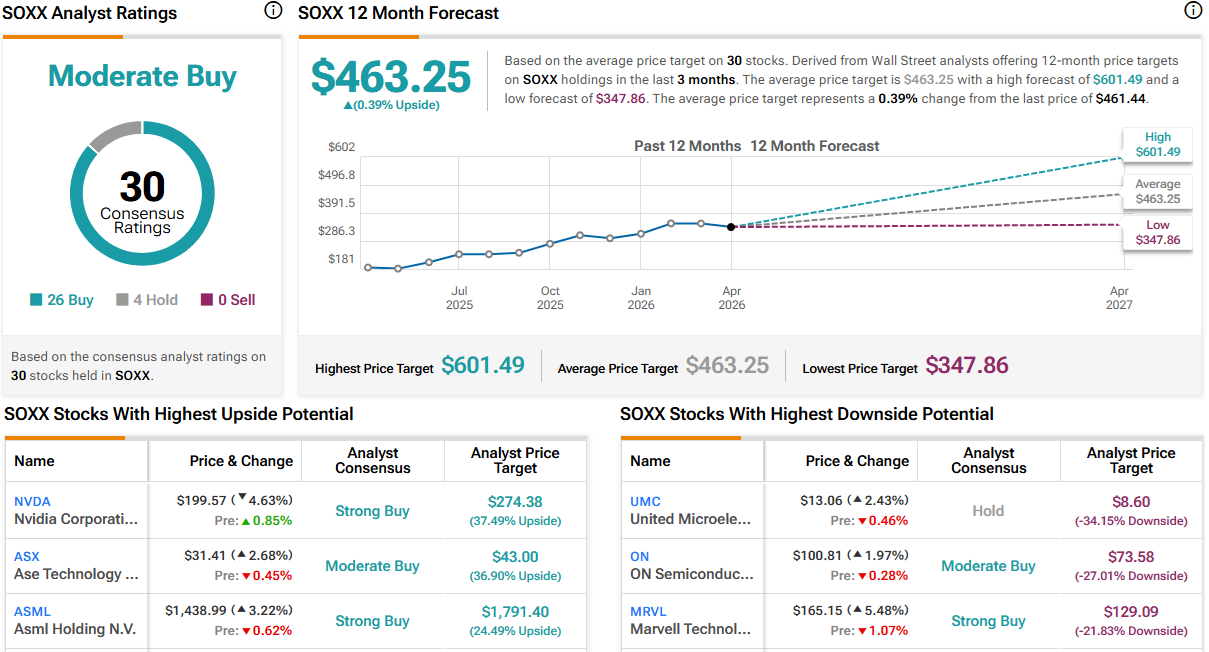
That is reflected in Wall Street’s take on the SOXX. The ETF’s average price target lands at $463.25, implying it will stay rangebound for the time being. Based on 26 Buys and 4 Holds, the SOXX claims a Moderate Buy consensus rating. (See SOXX stock forecast)