


Apple (AAPL) is increasingly reaching a point where future growth depends less on selling additional devices and more on convincing users to spend within its ecosystem. As the technology giant’s hardware business matures, I believe artificial intelligence (AI) can help support the next phase of Apple’s growth story to some extent. The company’s new AI layer across the iPhone, iPad, and Mac is designed to deepen user engagement, strengthen ecosystem stickiness, and potentially support higher-value services and premium pricing over time.
Claim 55% Off TipRanks
- Unlock hedge fund-level data and powerful investing tools for smarter, sharper decisions
- Discover top-performing stock ideas and upgrade to a portfolio of market leaders with Smart Investor Picks
However, investors have already priced in steady earnings growth and much of the optimism around Apple’s AI opportunity. Therefore, I believe AI alone is not enough to fully justify the current premium valuation from a risk-reward perspective. So, despite remaining constructive on the business long term, I maintain a neutral stance on AAPL today.

A Strong Quarter, but Not a New Horizon Yet
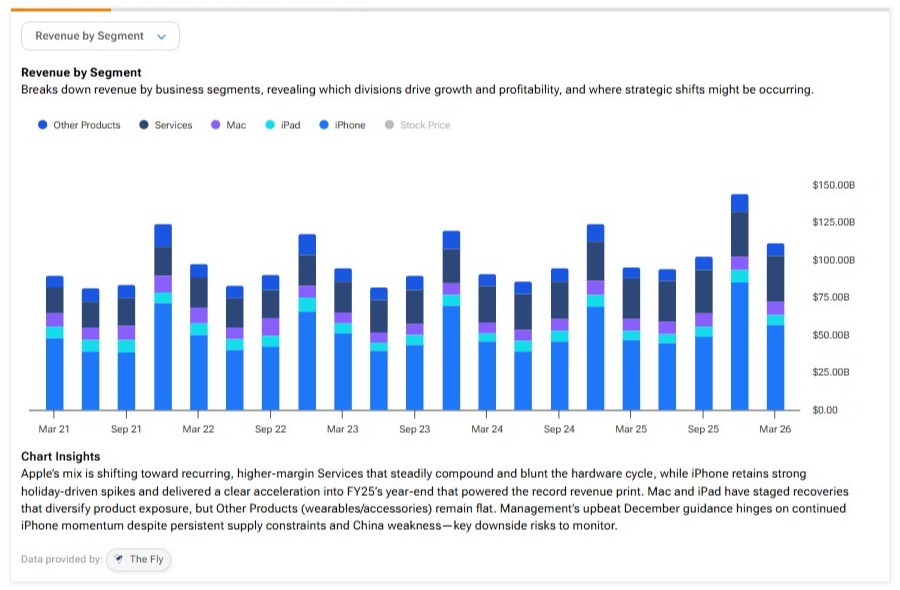
For Q2 fiscal 2026, Apple posted revenue of $111.2 billion, up roughly 17% year-over-year. Product sales were $80.2 billion, driven by strong demand for the iPhone, Mac, iPad, and wearables. Diluted earnings per share (EPS) were $2.01, up 22% year-over-year, helped by record iPhone revenue and robust demand across all geographic regions.
After the report, Apple’s Director Arthur Levinson sold over $71 million in stock, with Apple’s shares trading near record all-time highs and the company announcing a new $100 billion share buyback program. Despite the headline sale, it appears to be largely profit-taking, as he still holds over 3.8 million shares valued at over $1 billion at recent prices.
These results confirm that Apple remains an earnings powerhouse, but they do not yet demonstrate that Apple Intelligence is a significant standalone revenue driver. For now, AI appears to be a promising enabler and cost center embedded in Apple’s integrated hardware-plus-services model rather than a separate, high-priced growth engine.
Mature Hardware Meets a Growing Installed Base
Among the product segments, iPhone revenue remains the largest contributor at $57 billion, with 22% year-over-year growth. While the iPhone 17 lineup drove a new March-quarter record, overall unit growth appears modest, with mix and pricing doing much of the heavy lifting.
Mac revenue reached $8.4 billion, benefiting from new products and the M-series chip, while iPad revenue hit $6.9 billion. So far, Apple has embedded many AI features from Apple Intelligence into the latest versions of iOS, iPadOS, and macOS, while reserving some capabilities for higher-end hardware and potentially richer iCloud and service bundles.
Apple’s installed base of active devices has now surpassed 2.5 billion globally, a figure that continues to hit new highs across product categories and geographies. This base is the economic foundation for services and Apple Intelligence; each incremental device adds to a recurring revenue pool, and each new AI feature can be deployed to hundreds of millions of users at relatively low marginal cost.
Services Are the Margin Engine
Services have become one of Apple’s most dependable growth and margin levers, and the latest numbers underscore that trend. Services revenue hit a record of $30.98 billion, up 16% year-over-year, as it monetized its vast installed base through subscriptions, cloud services, and payments, with strong momentum in digital content, advertising, and financial services.
If Apple Intelligence deepens engagement and increases average revenue per user (ARPU) across subscriptions, cloud, payments, and advertising, it could arguably sustain revenue growth.
Apple currently trades at a trailing P/E ratio of roughly 35.7x, indicating a premium valuation, with the stock trading above its 5-year average of 29.8x. Apple is also currently trading at a higher trailing multiple than several of its “Magnificent” peers. This indicates investors are paying a higher multiple for Apple’s earnings than its historical average and versus many large-cap peers, reflecting confidence that services growth and Apple Intelligence can offset hardware maturity and margin pressure from rising costs.
Regulation and Geopolitical Risk
Regulation remains a major drawback for Apple’s services story. Ongoing scrutiny of the App Store’s commission structure, default search agreements, and new Digital Markets Act (DMA) regimes in Europe and beyond could pressure take rates or force changes to Apple’s prioritization of its own services. Even modest changes to fees could slow the growth of services, particularly in App Store and advertising revenue.
At the same time, Apple faces geopolitical and supply-chain risks, including potential tariffs and swings in regional demand, that could affect hardware margins and pricing power. While Apple has made headway diversifying production into other regions, its exposure to China remains considerable relative to many Western peers. Some investors have advised looking elsewhere for higher returns, despite Apple hitting record highs.
These regulatory and geopolitical risks are partially offset by Apple’s formidable cash generation and capital return program. With over $100 billion in annual net income and a history of aggressive share repurchases, the company has ample flexibility to support EPS growth even in a slower revenue environment. That buyback and dividend backdrop provides a valuation floor, but it does not fully insulate investors if regulatory changes materially reduce the services’ profit pool.
What Is the Market’s View?
On TipRanks, AAPL has a Moderate Buy consensus rating. Of 28 Wall Street analysts’ ratings over the past three months, 17 were Buys, 10 were Holds, and one was a Sell. The average 12-month AAPL price target on TipRanks is $314.78, implying a 5.32% upside from the last price of $298.87.

The highest price target is $400, while the lowest is $250. Broader data from TipRanks also assigns AAPL a Smart Score of 7. Analyst sentiment remains split, with bulls complimenting the company’s product innovation and ecosystem expansion, while bears criticize input cost pressures and manufacturing risks.
Final Thoughts
Apple has already proven that it can turn a massive hardware base into a recurring, high-margin services franchise, and Apple Intelligence is a rational next step to further monetize that base. With record revenue, robust margins, and a growing installed base, the company appears well-positioned to offset the effects of hardware maturity and sustain solid earnings growth over time.
Based on its current valuation, I see Apple as a high-quality, reasonably valued compounder rather than an apparent bargain, with a balanced risk/reward profile that depends on whether AI and services can continue to outpace regulatory and competitive headwinds.