


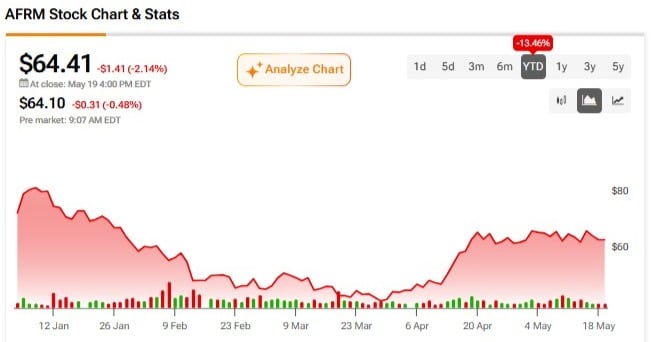
Affirm Holdings’ (AFRM) growth targets suddenly look more believable and less ambitious, as the momentum builds, keeping me bullish on this fintech buy-now-pay-later (BNPL) leader. The company has recovered impressively, rising more than 40% from its March lows. Still, the stock remains modestly in the red or roughly flat year‑to‑date, which suggests investors are not yet fully convinced.
Claim 55% Off TipRanks
- Unlock hedge fund-level data and powerful investing tools for smarter, sharper decisions
- Discover top-performing stock ideas and upgrade to a portfolio of market leaders with Smart Investor Picks
I understand the hesitation. Affirm is not a sleepy value stock, and its medium-term targets require a lot to go right. However, after its recent Q3 results and Investor Forum, I think the company is showing enough operating momentum, funding discipline, and product expansion to justify a bullish view.
The $100 Billion GMV Target Is Aggressive, but Not Fantasy
The headline from Affirm’s Investor Forum was its new medium-term target of $100 billion in gross merchandise volume (GMV), up from about $46 billion over the latest trailing 12-month period. That implies more than 25% annual GMV growth, which is a high bar. However, I do not think it is an unrealistic bar.
Affirm has multiple ways to get there. Management expects growth to come from merchant point-of-sale expansion, direct-to-consumer adoption, and international growth. The Affirm Card is especially important. Today, the card has about 4.4 million users with an average annual spend of roughly $2,400. Over time, management sees a path to 20 million users and $7,500 in annual spend, creating a very large card-based GMV opportunity.
There is also room to deepen enterprise penetration. Affirm currently works with 75 of the top 250 U.S. e-commerce merchants, leaving a long runway of large retailers still to convert. That matters because Affirm is already driving billions in GMV through some merchants even before becoming a fully integrated payment option.
The Latest Quarter Supports the Bull Case
Affirm’s fiscal third-quarter results were not just “good enough”; they were strong. Revenue rose 33% year-over-year to $1.04 billion, beating expectations. GMV increased 35% to $11.6 billion, while revenue less transaction costs grew 41% to $498 million. Adjusted operating income jumped 62% to $281 million, and adjusted operating margin expanded to 27%. That is the key point for me. Affirm is not just growing GMV; it is showing real operating leverage.
Active customers also increased to 26.8 million as of March 31, 2026, up from 21.9 million a year ago, while transactions per active consumer rose to 6.7 from 5.6. That suggests stronger repeat usage, not just one-time adoption.
The company did see delinquencies rise, and that is worth watching. However, management attributed part of the increase to tax-refund-driven prepayment dynamics, and the broader consumer book still appears healthy. I would not ignore credit risk, but I also do not see evidence of a consumer crack inside Affirm’s portfolio right now.
Funding Is Becoming a Bigger Advantage
One underrated part of Affirm’s story is funding. BNPL companies live and die by access to capital. Affirm has built a diversified funding structure with roughly 200 unique funding partners across warehouse facilities, asset-backed securitizations, and forward-flow agreements. As the company scales and proves credit performance, it should be able to lower funding costs over time.
That creates a quiet but powerful flywheel: more scale can lead to better funding terms, which can support better economics and more merchant adoption.
The planned Affirm Bank could add another layer. If approved, it would allow Affirm to offer high-yield savings accounts and use deposits as another funding source. Management is targeting about 5% of loans funded with deposits by the end of the de novo period. That is not transformative immediately, but it could improve long-term flexibility.
Agentic Commerce Could Be a Wild Card
Affirm’s integration with Google Search (GOOG), AI Mode, Gemini, and Google Pay is a meaningful development. As AI agents begin helping consumers discover and buy products, payments, and credit options need to be transparent, embedded, and trusted. That plays directly into Affirm’s brand.
I like this angle because it gives Affirm exposure to a potential new commerce layer without needing to own the entire shopping journey. The company is positioning itself as an “affordability layer” across Google, Stripe, Shopify (SHOP), and future agentic commerce protocols.
This is still early. I would not put too much value on it today. Yet it is the type of optionality that could make the $100 billion GMV target look less stretched in the future.
Valuation Is Not Cheap, but Growth Deserves a Premium
Affirm trades at a premium to many peers. Its forward P/E ratio is around 38x, which is lower than its three-year average of about 69x, while its price-to-free-cash-flow ratio of about 28.4 is above its five-year average of 20.71.
The forward P/E of 38x appears expensive compared to traditional legacy financial institutions, which trade closer to 12x. However, I think the valuation makes more sense when viewed against the company’s growth profile. Management’s medium-term framework calls for 7.5% to 8.5% revenue as a percentage of GMV, 3.75% to 4.0% Revenue Less Transaction Costs (RLTC) as a percentage of GMV, and 30% to 35% adjusted operating income margins.
Those are ambitious targets, but they also show what the model could look like at scale. If Affirm continues compounding GMV above 25% while expanding margins, the stock can still work from here.
Wall Street’s View
According to TipRanks, Affirm has a Strong Buy consensus rating, with 17 Buy, five Hold, and no Sell ratings. Based on 22 Wall Street analysts, the average price target is $85.95, implying 34.21% upside from the recent price of $64.04.

Conclusion
Affirm is not risk-free. The stock is volatile, the valuation is not cheap, and any deterioration in consumer credit would quickly pressure sentiment.
Still, I think the positives outweigh the risks. Affirm is growing GMV rapidly, improving operating leverage, building a stronger funding model, expanding its card opportunity, and positioning itself for agentic commerce. The $100 billion GMV target is bold, but after the latest quarter and Investor Forum, it feels more credible than aspirational. I remain bullish on AFRM.