


Adobe’s (ADBE) stock still trades at depressed levels. Yet, the business itself is clearly far healthier than the share price suggests. The market remains stuck on the idea that artificial intelligence (AI) will kill the creative and digital solutions software company’s very business model. However, the numbers continue to show growth, rising earnings, and, importantly, early signs that AI is becoming part of the upside rather than a threat. With Q2 expected to remain solid and a valuation still deeply compressed, the stock appears priced for a much more dire case than the evidence currently supports. That is why I remain bullish on ADBE.
Meet Samuel – Your Personal Investing Prophet
200% short exposure to NVDA with NVDS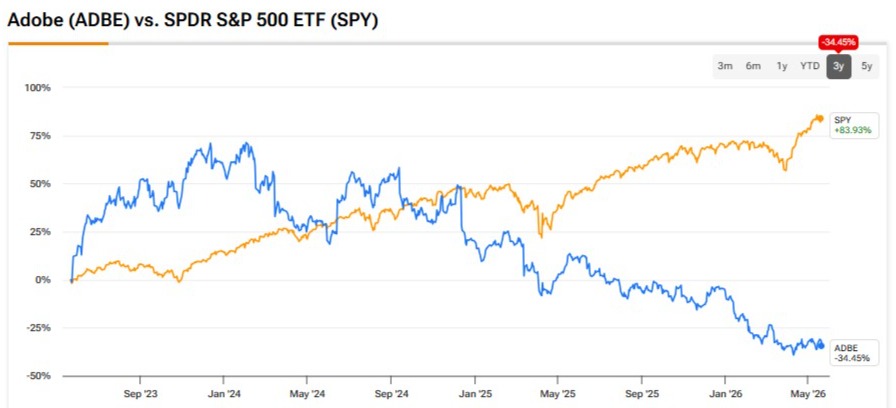
The AI Fear Is Becoming Ever Less Credible
The bear case for Adobe is easy to support. If generative AI can create images, videos, documents, and marketing assets with a few prompts, then maybe Adobe’s old advantage starts to matter less. That fear has been weighing heavily on the stock for a while. Honestly, it is not an absurd fear. However, it is also not what is actually happening, or, at least, it is not negatively affecting the company.
In its latest results back in March, Adobe reported record revenue of $6.4 billion, up 12% year-over-year, with subscription revenue up 13%. Adjusted earnings per share (EPS) came in at $6.06, up 19%. However, most importantly for the AI debate, management said AI-first annual recurring revenue (ARR) more than tripled year-over-year. That is the point I keep coming back to. Bears have argued that AI will erode demand for Adobe’s Creative Suite, but so far, the company has shown that AI can also add value to the model.

I particularly like how Adobe has been active in commercially relevant AI. It has partnered with Nvidia (NVDA) on next-generation Firefly models and agentic creative and marketing workflows, introduced Firefly AI Assistant, and recently extended that agentic push into Acrobat with a productivity agent for PDFs and content repurposing. So Adobe is trying to make AI useful inside the same professional environments where its customers already work. That doesn’t end the bear debate, but it does weaken the idea that Adobe is simply watching AI happen from the sidelines.
Q2 Should Support the Bullish Case
Now, Adobe’s upcoming Fiscal Q2 2026 report is expected on June 11, and, given recent momentum and Wall Street’s forecast, results should once again support the stock’s bullish case. Analysts expect roughly $6.45 billion in revenue and adjusted EPS of $5.83, implying solid growth of 9.9% and 15.1%, respectively.
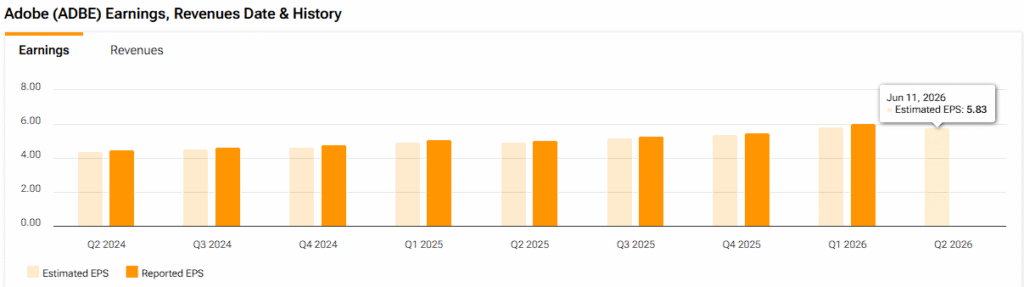
This growth is likely to be driven by the Creative Cloud, Acrobat, Firefly, enterprise content workflows, and customer-experience orchestration. Adobe’s Q1 showed Business Professionals & Consumers subscription revenue rising 16%, while Creative & Marketing Professionals subscription revenue rose 12%, setting up strong momentum for another robust quarter. And yes, those are not outrageously great numbers. Still, they suggest AI is becoming an upsell layer across the portfolio, countering the bear case.
I also find the Q2 estimates peculiar, precisely because the stock is trading as if deterioration is imminent. A business that is supposedly being disrupted into irrelevance should not be compounding revenue at a double-digit rate while expanding per-share earnings even faster. This brings us to the stock’s valuation.
The Multiple Has Fallen Off a Cliff
The valuation is where the bear case really evaporates, for me. At about $250 per share, ADBE trades on roughly 10.8x the $23.55 consensus EPS estimate for FY2026, at a steep 26% discount to the software sector median of 14.4x, and 9.7x the $26.39 estimate for FY2027. Those estimates imply double-digit EPS growth in both years, yet the market is trading the stock multiples that look more suitable for a company nearing perpetual decline.
That disconnect is hard to justify unless one believes Adobe’s growth will collapse soon. However, the evidence so far does not point that way. FY2026 guidance calls for total revenue of $25.90 billion to $26.10 billion and adjusted EPS of $23.30 to $23.50, with total Adobe ending ARR growth of 10.2%. While below Street estimates, this still points to excellent growth ahead. Adobe has a recurring subscription model, with high margins, deep enterprise relationships, and a growing AI layer. It clearly does not deserve to be priced like a melting ice cube.
Capital returns strengthen the case for a potential rerating. Adobe approved a new $25 billion repurchase program last month, while management framed it as a sign of confidence in cash flow and long-term value. The current buyback yield is also elevated, at around 10.3%, and with the stock trading at record-low valuation levels and a new massive program, a tremendous buyback yield is likely to persist. This should provide a relative floor for the stock price and also boost the company’s per-share metrics in the long term.
Is ADBE Stock a Buy, Sell, or Hold?
Despite its prolonged underperformance, Adobe stock features a Moderate Buy consensus rating on Wall Street, based on 10 Buy, 14 Hold, and two Sell ratings. Moreover, ADBE’s average price target of $318.38 implies about 30% upside over the next 12 months.

Final Thoughts
I am not saying Adobe’s investment case is risk-free. AI might indeed end up being a real threat, and the stock may never recover toward its past highs. However, for now, we are looking at AI becoming Adobe’s pricing lever and enterprise workflow advantage. With both recent results and consensus estimates still pointing to excellent growth and EPS compounding in the double digits, today’s compressed valuation feels absurd. The case for Adobe as a value trap is weakening, but the case that it is actually a mispriced compounder is growing stronger.