


After several difficult years that left many private companies delaying their public market ambitions, the IPO environment finally appears to be regaining real traction. Wall Street entered 2026 with a far healthier backdrop for new listings, as improving investor sentiment and resilient equity markets encouraged more companies to test public demand. The rebound has been especially visible among technology, healthcare, and infrastructure-related businesses, where investors continue searching for companies capable of delivering durable long-term growth.
Meet Samuel – Your Personal Investing Prophet
- Start a conversation with TipRanks’ trusted, data-backed investment intelligence
- Ask Samuel about stocks, your portfolio, or the market and get instant, personalized insights in seconds
According to PwC’s Capital Markets Watch, the first quarter of 2026 produced the busiest opening quarter for traditional IPOs in five years, with 22 large-scale offerings collectively raising $9.4 billion. Investor appetite has also become more selective and disciplined compared to the speculative boom seen during the pandemic-era listing frenzy. Companies entering the public markets now generally need clearer profitability paths, stronger balance sheets, and more mature business models before attracting institutional demand.
Against this backdrop, Goldman Sachs analysts have been digging through the latest wave of IPO activity to separate the stronger opportunities from the rest of the field. Using data from the TipRanks database, we took a closer look at two recent IPO names that Goldman currently believes are positioned to outperform. Let’s dive in.
Aevex Corp. (AVEX)
The first stock we’re looking at here is Aevex Corporation, a US defense contractor. This California-based company focuses on advanced autonomy, unmanned systems, and mission solutions designed to provide an edge on the modern battlefield. The company has multiple facilities located across the US, where it develops products and solutions to shape the defense industry.
Aevex’s best-known products are its aerial drones. The company produces both long-endurance and precision-strike models, featuring modular designs and mission-ready performance. The drone systems are purpose-built to provide adaptability, reliability, and speed in difficult environments, and to let operators stay longer and see farther – in order to act decisively. Aevex not only produces drone aircraft; the company has extended the technology to surface water vessels, as well.
Finished products are not the only thing that Aevex offers for the defense industry. Mission solutions include such capabilities as additive manufacturing, which allows for the rapid production of drones in austere conditions; intelligence analysis, which can transform the complex data of the battlefield into usable insights; and aircraft integration, modification, and testing, which adapt existing airframes to new missions. And importantly, counter-UAS services strengthen forces’ defenses against unmanned threats of all sorts.
On the 13th of this month, Aevex announced that it had secured an $18.5 million contract with the US Air Force. The contract covers the delivery, along with engineering and field service support, of autonomous One Way Attack (OWA) aircraft.
Looking at the IPO, we see that Aevex priced its offering at $20 per share for 16 million shares. The stock hit the markets this past April 17. The company raised about $320 million in gross proceeds from the sale and today boasts a market cap of $1.31 billion. We should note that we’ll see Aevex’s first earnings release as a public firm this coming May 20.
Goldman Sachs analyst Noah Poponak finds this to be an exciting new stock, noting: “Aevex is an opportunity to invest in a defense tech company that sells into a rapidly growing end-market, and that has strong profit margins and cash flow on top of high rates of relatively early stage growth. Unmanned Aerial Systems (UAS) have proliferated the modern battlefield because they are low-cost, easy-to-produce, asymmetric assets that can be used for a wide range of missions. The majority of Aevex’s revenue comes from UAS sales, and we think the company’s products are competitive offerings that it can sell into rising unmanned defense budgets globally.”
Looking ahead, Poponak says, “We expect Aevex to have the highest organic revenue growth in the medium term, while profitability and free cash generation are strong, relative to other defense tech names in our coverage, despite having the smallest revenue footprint in the group.”
These comments support the analyst’s Buy rating, while his $34 price target implies a 31% gain for the stock over the next 12 months. (To watch Poponak’s track record, click here)
Overall, this newly public stock has attracted 9 analyst reviews in its short time on the market, and those are all positive, for a unanimous Strong Buy consensus rating. The shares are trading for $25.89, and the $35.25 average target price suggests that they will gain 36% by this time next year. (See AVEX stock forecast)

PayPay Corporation (PAYP)
For the next stock, we turn to Japan. PayPay positions itself as Japan’s leading digital finance company, providing a broad range of financial and payment services through its ecosystem.
At the user/customer level, that means that PayPay creates the ultimate convenience – applications that allow users and businesses to turn everyday smartphones into a comprehensive, simplified, and readily accessible financial platform. We all have smartphones in our pockets – PayPay makes it possible to use them to conduct routine financial transactions and payment transfers.
The apps allow users to make payments by scanning barcodes or QR codes at stores or online, while linking seamlessly to bank accounts, credit cards, and debit cards. PayPay now serves roughly 73 million registered users and also enables peer-to-peer money transfers, utility bill payments, and other everyday financial transactions, alongside digital security features designed to safeguard customer funds.
The company held its IPO in March, and the stock started trading on March 12. A total of 54,987,214 American Depositary Shares went on the market; of that total, PayPay offered 31,054,254, while a selling shareholder put up another 23,932,960 shares. The shares went on the market at $16 each, which was below the initial range of $17 to $20. We should note that PayPay only realized gross proceeds from the shares it sold directly; this came to just under $497 million. The company has a current market cap of ~$13 billion.
For Goldman Sachs analyst Makoto Kuroda, the key here is PayPay’s strong user base and its clear strength in the fintech niche.
“We view PayPay as a top-performing fintech in our coverage, given its leading position in Japan’s QR code payments, scalable model and expansion to credit cards/financial services, which have resulted in 20%+ CAGR growth and higher profit margins in recent years. PayPay’s scale is differentiating, at 72 million registered users including 41 million active users and 40 million eKYC users (as of Mar 2026). Meanwhile, PayPay is underpenetrated on financial services, but stands out from other fintech/payments peers with fast deposit growth and some 19% contribution to net revenue, where others have taken a slower, organic approach,” Kuroda commented.
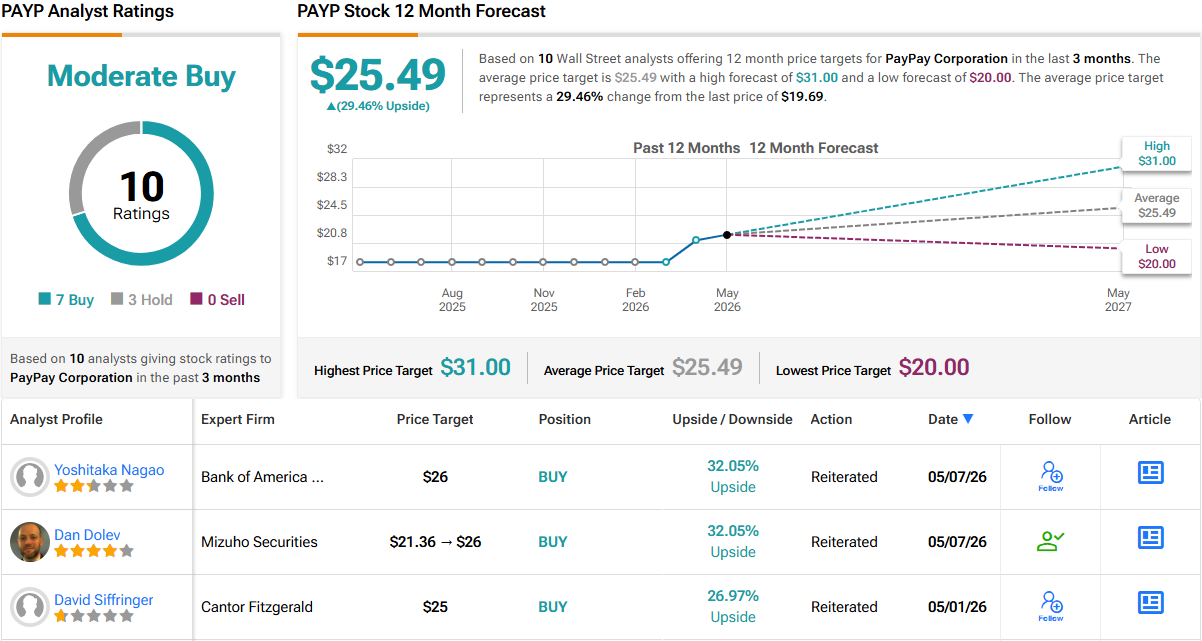
Kuroda sets a Buy rating on the stock, and gives the shares a $31 price target, implying a one-year gain of 57%. (To watch Kuroda’s track record, click here)
All in all, the 10 recent analyst reviews include 7 Buys and 3 Holds, giving the stock a Moderate Buy consensus rating. Shares are trading at $19.69, while the average price target of $25.49 implies a 29% upside potential over the next year. (See PAYP stock forecast)
Disclaimer: The opinions expressed in this article are solely those of the featured analysts. The content is intended to be used for informational purposes only. It is very important to do your own analysis before making any investment.