As the restaurant industry faced another difficult year in 2025, many well-known chains decided to close underperforming locations in order to stabilize their businesses. Unsurprisingly, inflation continued to pressure consumers, which led more people to eat at home or look for discounts when dining out. As a result, restaurant traffic declined in almost every month of 2025, except July, according to Black Box Intelligence. In response, closures spread across nearly every segment of the industry. The companies involved include:
Claim 30% Off TipRanks
- Unlock hedge fund-level data and powerful investing tools for smarter, sharper decisions
- Discover top-performing stock ideas and upgrade to a portfolio of market leaders with Smart Investor Picks
- Starbucks (SBUX)
- Wendy’s (WEN)
- Denny’s (DENN)
- Jack in the Box (JACK)
- Darden Restaurants (DRI), parent of Bahama Breeze
- Papa John’s (PZZA)
- Noodles & Company (NDLS)
- Bloomin’ Brands (BLMN), parent of Outback Steakhouse
Many of these closures were tied to specific turnaround plans. Specifically, Starbucks announced a $1 billion restructuring plan in September that included closing about 500 North American stores. Wendy’s also began reviewing its restaurant footprint, saying that it could close a mid-single-digit percentage of U.S. locations as part of its “Project Fresh” strategy after ongoing sales declines. Denny’s took a similar approach, planning to close 70 to 90 restaurants in 2025 before agreeing to a $620 million sale to private equity buyers, which is expected to close in early 2026.
Separately, Jack in the Box said it would close between 150 and 200 restaurants under its “Jack on Track” plan. Darden closed 15 Bahama Breeze locations and is now considering selling the brand or converting the restaurants into other concepts like Olive Garden. Meanwhile, Papa John’s closed 173 restaurants worldwide during the first three quarters of 2025, including 62 in the U.S., though it still operates nearly 6,000 locations. Noodles & Company continued shrinking its footprint, with more closures planned through 2026, while Bloomin’ Brands shut 21 restaurants and identified dozens more.
Which Restaurant Stock Is the Better Buy?
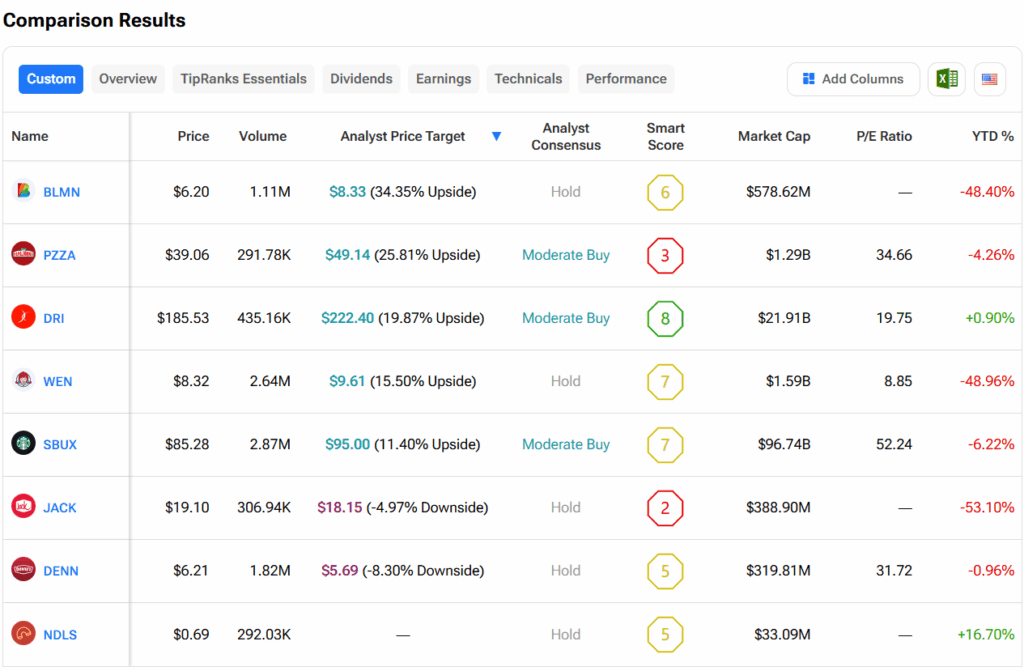
Turning to Wall Street, out of the restaurant stocks mentioned above, analysts think that BLMN stock has the most room to run. In fact, BLMN’s average price target of $8.33 per share implies more than 34% upside potential.