


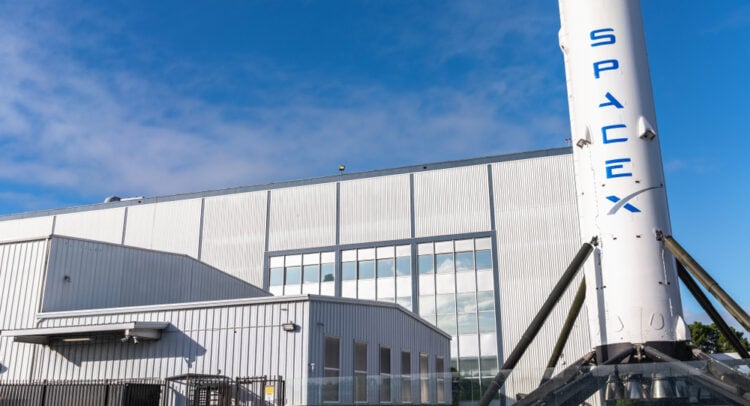
New updates have been reported about SpaceX.
Meet Samuel – Your Personal Investing Prophet
- Start a conversation with TipRanks’ trusted, data-backed investment intelligence
- Ask Samuel about stocks, your portfolio, or the market and get instant, personalized insights in seconds
SpaceX is preparing for a mid-March maiden test flight of its upgraded Starship V3, a larger and more powerful iteration of the vehicle that is central to the company’s next phase of growth, according to CEO Elon Musk. Starship V3 is designed to deploy heavier, next-generation Starlink satellites that promise higher data throughput, a critical enabler for expanding Starlink’s revenue base and supporting future enterprise and government customers. The new variant also introduces in-orbit docking capability between Starship vehicles, a technical milestone required for long-range missions to the moon and Mars and a key dependency for NASA’s plans to return U.S. astronauts to the lunar surface. These developments come as SpaceX reportedly moves toward an IPO later this year, with Starship’s performance and reliability likely to be central to investor confidence in the company’s long-term growth and valuation.
The V3 program has faced setbacks: a booster explosion during November gas-system pressure testing destroyed a section of the steel rocket and pushed back original plans for a late-2025 launch, and the company has not yet disclosed a detailed root-cause analysis. Earlier Starship V2 flights yielded mixed but strategically important results: the vehicle reached orbit, successfully deployed dummy next-gen Starlink satellites, and executed multiple booster recoveries, while also experiencing several explosions both in flight and on the ground, consistent with SpaceX’s strategy of rapid iteration through aggressive testing. Maintaining its lead in the global launch market now hinges on successfully fielding Starship at scale, as competitors begin to close the gap: Blue Origin’s New Glenn has completed multiple flights, including a NASA commercial mission and a booster landing, and a larger variant is in development to more directly challenge Starship’s heavy-lift segment. For SpaceX, a successful Starship V3 campaign would not only secure its Starlink deployment roadmap and sustain launch-market dominance, but also reinforce its role as a critical partner in U.S. lunar ambitions at a time of heightened political and strategic pressure on schedule performance.