Social media giant Meta Platforms (META) has long been branching out into hardware. One of its biggest advances has been in smart glasses. But as it turns out, Meta is not the only company chasing such ambitions. Chinese manufacturers are working on their own entrants into the wearable device market, with one extra advantage: artificial intelligence.
Claim 30% Off TipRanks
- Unlock hedge fund-level data and powerful investing tools for smarter, sharper decisions
- Discover top-performing stock ideas and upgrade to a portfolio of market leaders with Smart Investor Picks
A Strange But Adept History
Chinese mobile device development has always been its own animal. Back in the 2010s, Chinese developers brought out entire lines of mobile phones that were both wildly innovative and periodically anachronistic. Some phones included built-in analog televisions, largely useless as the digital conversion was starting to kick in. Others had gamers in mind, with gamepads built into the phones. So counting the Chinese out is likely a bad idea.
In fact, a CNBC report noted that there were over 70 Chinese companies working to make their own wearable devices, and many of them were looking to introduce artificial intelligence into the mix.
And wearable devices are not exactly new. Wearable tech used to be a buzzword 10 to 15 years ago. Devices like the Fitbit and the Apple (AAPL) Watch caught a lot of attention and suggested a lot of things were possible.
The Chinese, meanwhile, are taking full advantage of that possibility. Several firms are branching out into the smart glasses market, but that is not all. One device, the DingTalk A1, is a small device—about the size of a credit card—that allows for note-taking on the job without need for pencil, paper or stylus. It can not only record notes, but reports note it can also transcribe them, summarize, and analyze from spoken word said from a distance of up to 26 feet. This is actually quite a feat given how background noise can ruin a recording from half that distance or less.
It gets better, though; the Native Language Star from Le Le Gaoshang Education Technology offers a kind of translation device. It translates Chinese into English, and was intended for parents who have little English to teach English to their children. Though there are reports that the device is somewhat unusual in its form factor. This may make it less a viable device for wide use and more of a niche product. Still, today’s niche product can be tomorrow’s game-changer with some retooling and further testing, so China may be the farthest along toward a dedicated wearable translator device.
Future Applications
The future, meanwhile, is actively shaping up in favor of such development. Though wearable technology is nothing new, and can be said to have lost some of its buzz over the last several years, the technology is still seeing development.
Right now, reports note, developments are moving toward three key points: smart rings, health monitors without displays, and controllers that work by gestures. These are actually developments in the Chinese wheelhouse; having focused on wearable devices like watches for so long means that Chinese developers need only pivot to new form factors. And their work in translation system development will serve them well here too. Consider a translator built into a ring, and its potential impact on foreign travel.
It gets better from there; that ring form factor can easily serve as the basis for a health monitor. Pulse oximeters often clip to a finger, after all. And gesture controls can easily make their point of contact the finger. The ring, ultimately, could be the best form factor yet for an entry in wearable technology, beating out even glasses.
Wearable technology is nothing new. And smart glasses have been advancing steadily ever since Google (GOOGL) Glass’ first appearance back in 2012. Is the ring the future of wearable technology? Do the Chinese have an insurmountable edge already? Only time will tell, but the early going suggests a lot of new developments in the making. Where they come from, and what they do, will truly tell us if Meta Platforms can come out on top or not.
Is Meta Platforms a Buy, Sell or Hold?
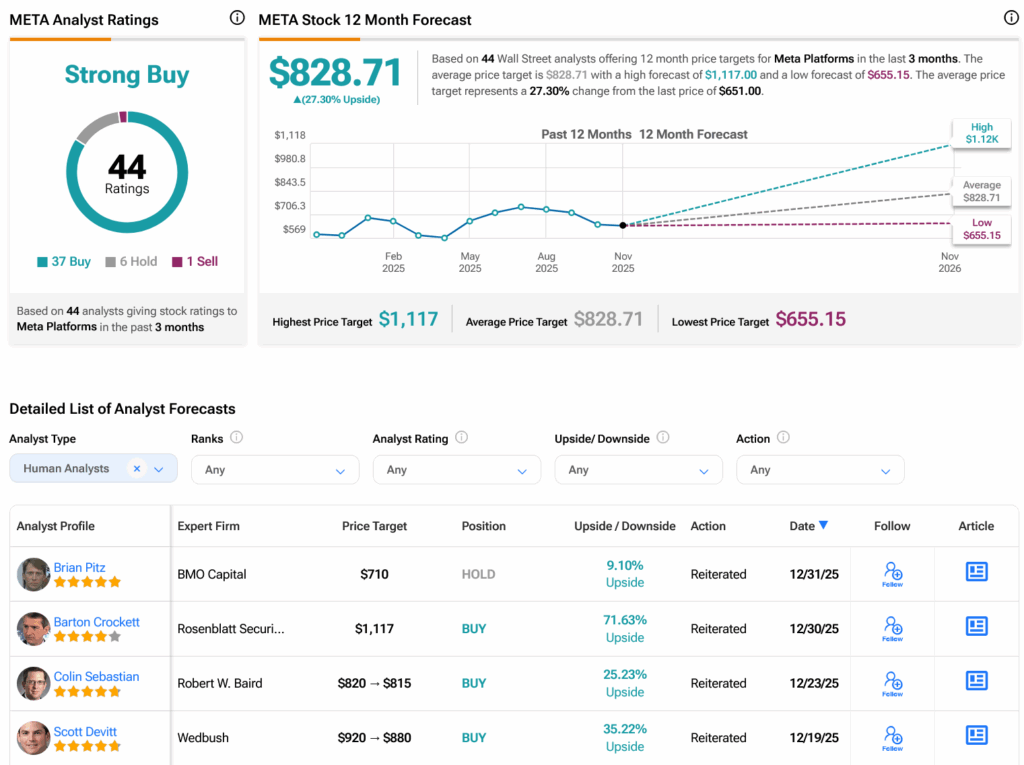
Turning to Wall Street, analysts have a Strong Buy consensus rating on META stock based on 37 Buys, six Holds and one Sell assigned in the past three months, as indicated by the graphic below. After a 9.17% rally in its share price over the past year, the average META price target of $828.71 per share implies 27.3% upside potential.