The concept of a marketing stunt is not, in and of itself, new. Those of us of a certain age remember a certain fictional radio personality swear, heartbroken, “As God is my witness, I thought turkeys could fly!” Arthur Carlson’s stunned pronouncement aside, marketing stunts are a little less-seen these days, except perhaps on social media, where they remain alive and well. Retailer GameStop (GME) has made a lot of moves in this vein, and many of them are still recent, so let’s take a quick look on this holiday at three of the best marketing stunts GameStop brought out.
Claim 55% Off TipRanks
- Unlock hedge fund-level data and powerful investing tools for smarter, sharper decisions
- Discover top-performing stock ideas and upgrade to a portfolio of market leaders with Smart Investor Picks
3. Karissa the Destroyer
This one takes us back to the depths of 2015, and back when competitive Super Smash Bros. was getting started. On the scene emerged a downright legendary figure, a 10-year-old girl named Karissa. Karissa soon became known as “Karissa the Destroyer,” as she rampaged her way through a tournament in West Hollywood.
Karissa was not just good; she was clearly expert. She was using techniques considered “advanced” for the time, and with a degree of proficiency that suggested years of practice. Analysis was downright baffling, as Karissa was found to be a master of “frame traps,” small intervals between a player getting hit and being able to respond. And that was when GameStop pulled back the veil.
Karissa was little more than an actress, and the incredible gameplay was conducted by a competitive Super Smash Bros. player hidden behind the demo kiosk. But for a while there, it certainly looked like this 10-year-old was taking players twice, even three times, her age to school at a tournament with a demo kiosk.
2. Was it a Red Swingline?
Staplegate. This was a term that made some cringe, until GameStop seized the bull by the horns and snatched victory from the jaws of defeat so hard that defeat chipped a tooth. Back around the middle of the year, GameStop stapled receipts to Nintendo Switch 2 boxes on launch day. Ordinarily, this would not be such a problem, but in this case it was. The staples went through the boxes with sufficient depth and force to damage the screens, and left a lot of customers extremely displeased.
But that was when the victory-snatching kicked in. GameStop CEO Ryan Cohen turned it into a marketing stunt / charity event for the Children’s Miracle Network Hospitals. The offending stapler was auctioned off, as was a stapled console and the bent staple. The combination sold for $250,000, and Cohen offered up some extras on top of it, including a pair of his own underpants to round it out. Had the auction gone farther, he would have personally taken the winner to lunch.
Staplegate might have left a bad taste in customers’ mouths, and forced GameStop to offer tepid apologies and restitution, a move that would have left it looking, at best, begrudgingly strong by taking its metaphorical L with grace. But thanks to Cohen, the whole thing turned into a convivial event complete with benefits for charity, and made GameStop look almost heroic for ruining those consoles.
1. Trade Anything. Seriously. Anything. Well, Pretty Much
The trade-in policy at GameStop has often left a bad taste in customers’ mouths. Back when more games were released physically, people would bring discs back to GameStop to trade for new games. Used games, meanwhile, found new life with those who had not purchased them yet, and GameStop could potentially sell the same game multiple times. That practice fell out of favor as digital distribution kicked in, but does still have some life left in it. Thus, the Trade Anything Day event was born.
And boy, did people bring Anything to trade. The Anything in question started with taxidermied animals, including a goose and a bobcat. Someone brought a pair of Air Jordan sneakers, which could have been pretty valuable. Someone brought copies of the TV show Friends…on VHS. Yes. Actual videocassettes of Friends, which at this point are definitely in the collectible range if not actual antiques. Though the amounts may not have been much, everyone got some trade-in credit, and GameStop ended with an eclectic mix of whatnot to try and get rid of later.
But more than that, GameStop also got people to come into the stores to offer up their random items for trade. Plus, it likely made a few sales that would not otherwise have been made, as people now had discounts from their random tradable items that they would have to apply toward in-store purchases. And this is the kind of thing that GameStop can repeat at any time, a development that allows it access to free marketing copy from places like this, who write, with relish, all about the bizarre junk that GameStop was willing to take in trade.
Is GameStop a Buy, Sell or Hold?
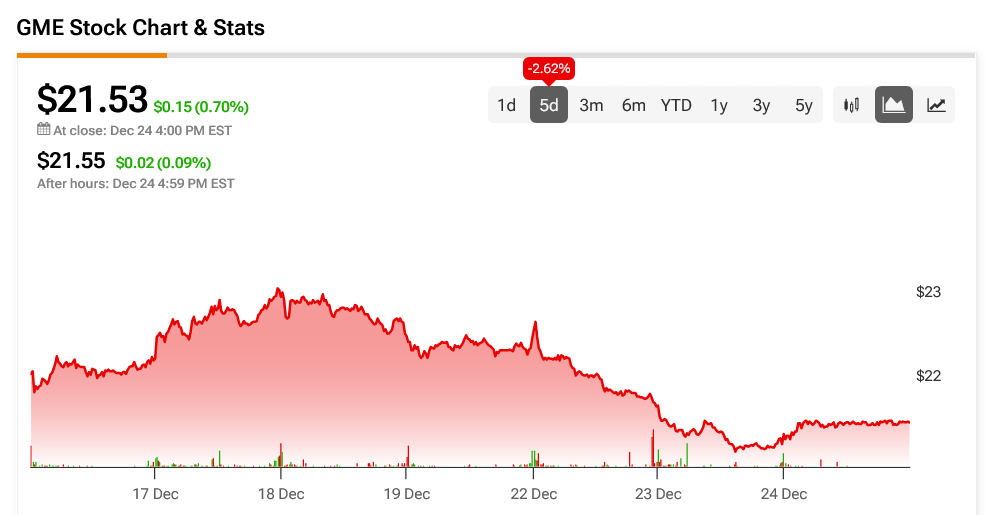
Turning to Wall Street, no analysts currently hold a position on GME stock. After a 34.74% loss in its share price over the past year, a look at the last five days of trading in GME stock shows substantial volatility. A slight recovery toward the early part of the period was ultimately given back, and most recently, movement is flat.