A federal judge rejected a U.S. business group’s challenge to overturn President Donald Trump’s $100,000 fee on new H-1B visas for highly skilled foreign workers. The judge upheld the decision, ruling that the fee falls well within the president’s broad powers to regulate immigration. The ruling is likely to impact technology and services companies the most, as they frequently hire specialized talent from overseas.
Claim 55% Off TipRanks
Trade AMZN with leverageThe U.S. Chamber of Commerce and the Association of American Universities argued that the administration lacked the legal authority to enforce the $100,000 H-1B visa fee. Among the top businesses lobbying against the decision were Amazon (AMZN), Microsoft (MSFT), Tata Consultancy (IN:TCS), Apple (AAPL), and Alphabet (GOOGL).
The Road Ahead for Skilled Workers
Daryl Joseffer, the Chamber’s top lawyer, said the new fee could be unaffordable for many small and medium-sized businesses. He expressed disappointment and indicated potential further legal action to ensure the H-1B program aligns with Congress’s goals. The H-1B program allows U.S. employers to recruit foreign workers with specialized training across diverse sectors. Amazon received the most H-1B visas, with over 10,000 approvals, followed by Tata Consultancy. Notably, California has the largest share of H-1B workers.
The H-1B program issues 65,000 visas annually, plus 20,000 more for individuals with advanced degrees. The visas are valid for three to six years. Trump’s order would raise the cost of obtaining these visas from the current $2,000-$5,000 bracket higher, forcing employers to either pay substantially more for labor or hire fewer highly skilled foreign workers.
Meanwhile, the U.S. has overhauled the H-1B visa system, scrapping the lottery in favor of a weighted process that prioritizes higher-skilled, higher-paid workers. The new system takes effect February 27, 2026, for the next cap-registration season and includes a rule requiring employers to pay an extra $100,000 per visa.
Which Is the Best Technology Stock, According to Analysts?
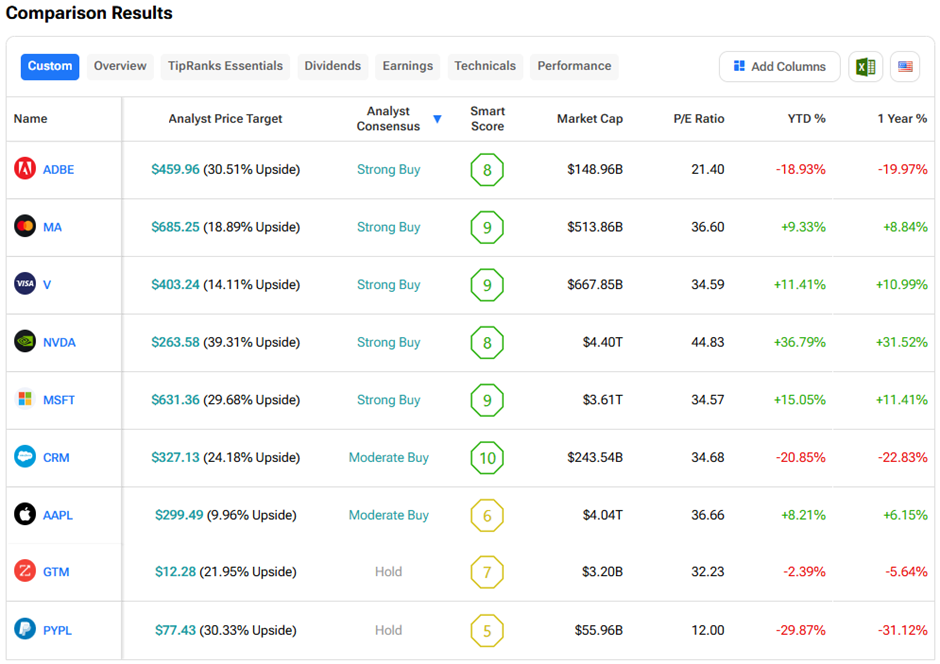
We used the TipRanks Stock Comparison Tool for Top Technology Stocks to determine which stock is most favored by analysts.
Currently, Wall Street has assigned a “Strong Buy” consensus rating on Adobe (ADBE), Mastercard (MA), Visa (V), Nvidia (NVDA), and Microsoft. NVDA offers the highest upside potential among them.