Big technology companies are starting to look beyond Earth to solve a growing AI problem. The issue is simple. Training AI models uses massive amounts of power, and land-based data centers are running into limits.
Claim 30% Off TipRanks
Trade AMZN with leverageIn that respect, Alphabet (GOOGL) announced Project Suncatcher late last year. The plan is to launch two test satellites in early 2027. These satellites will run AI chips using constant solar power in orbit. Over time, Google believes space-based data centers could become common.
At the same time, Nvidia-backed (NVDA) startup Starcloud trained an AI model in space for the first time in December. The company used Google’s Gemma model on a satellite. This showed that AI systems can work beyond Earth, at least on a small scale.
Meanwhile, spending on Earth continues to rise. OpenAI plans to invest about $1.4 trillion in data centers over the next eight years. Microsoft (MSFT) expects to spend about $80 billion in fiscal 2025 alone. Meta Platforms (META) and Amazon (AMZN) are also investing heavily. As a result, power grids and water systems are under strain, especially in the U.S.
SpaceX and the Business Case
Against this backdrop, Space Exploration Technologies, known as SpaceX, is moving deeper into AI computing. The company confirmed it is preparing for a possible 2026 initial public offering. Executives have said some of the money would go toward AI data centers in space. SpaceX is valued at nearly $800 billion in private markets. Its advantage is clear. It controls rockets, satellites, and launch costs under one roof. Elon Musk has said space could become the cheapest place to train AI within five years.
Even so, challenges remain. Launch costs are still around $2,000 per kilogram. Many experts say costs need to fall closer to $200 per kilogram to make space data centers practical. In addition, cooling chips in space and dealing with radiation are unresolved issues. Another concern is debris. Millions of objects now orbit Earth. In November, a Chinese spacecraft suffered window damage from a small fragment. This raised new attention on safety risks in orbit.
Still, interest keeps growing. Starcloud plans to launch a larger satellite with a GPU cluster by late 2026. The company aims to offer space-based computing services by early 2027. Leaders like Nvidia’s CEO Jensen Huang, Jeff Bezos, and Sam Altman have spoken in support of the idea.
For investors, the takeaway is straightforward. AI growth is pushing companies to search for new sources of power and scale. Space-based data centers remain early and risky. However, they point to how far companies may go to keep AI expansion on track.
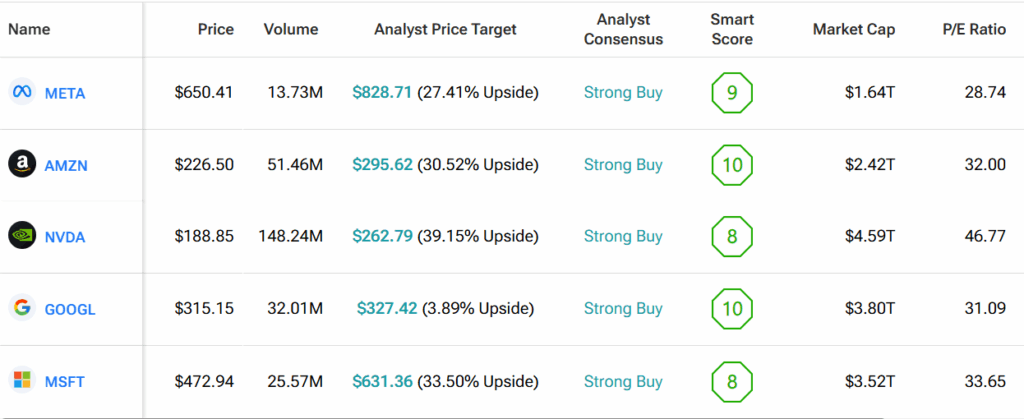
We used TipRanks’ Comparison Tool to align all the big tech companies appearing in the piece. It’s a great way to gain an in-depth look at each stock and the AI industry as a whole.