



Sandisk (NASDAQ:SNDK) stock has been on an amazing run, with the stock skyrocketing more than 4,000% over the past year. The massive rally has been fueled by rising AI-related NAND demand and by the view that NAND has become less cyclical due to $42 billion in long-term hyperscaler agreements. Additionally, its current gross margins are seen as reflecting a lasting structural shift.
Meet Samuel – Your Personal Investing Prophet
SNDK has a long & short ETF? Explore SNXX & SNDQBut does the performance signal a durable improvement in its business model or instead mark the most extreme cyclical high the industry has ever experienced? Investor Louis Gerard thinks the latter might be the case.
Of all the blowout metrics in the company’s most recent quarterly report, Gerard says the gross margin of 78.4% was the “most startling metric.” That level is way above the NAND industry’s typical 30%–40% range, which is normally already considered strong. According to Gerard, a margin near 78% almost implies a temporary break from the usual dynamics of commodity-market competition. The jump from 22.5% just four quarters earlier could rank among the biggest margin expansions ever seen in the semiconductor sector. However, this surge was closely tied to the datacenter business, where revenue climbed 645% year-over-year to $1.47 billion, driven by demand for high-capacity enterprise SSDs.
Meanwhile, to support its valuation, Sandisk has promoted a “New Business Model” built around long-term supply agreements aimed at reducing the memory industry’s historic cyclicality. These multi-year contracts, backed by financial guarantees, are expected to cover more than half of fiscal 2027 bit shipments. That said, Gerard is skeptical here as the longer-term portions of the agreements use variable pricing rather than fixed prices. As a result, while the contracts protect against customers walking away, they do not shield Sandisk from future price declines, particularly as new NAND supply from competitors such as Samsung and SK hynix ramps up in 2026.
Gerard’s concern is that the market may be valuing the company’s $42 billion RPOs (remaining performance obligations) as though they represent fixed-price revenue. Historically, NAND industry peaks have typically been followed by sharp margin compression within 12 to 18 months. While AI-driven storage demand could make this cycle somewhat different, major players, including Micron and SK hynix are still investing heavily in new capacity scheduled to come online in 2027 and 2028, increasing the risk of another oversupply cycle similar to those seen in 2019 and 2023.
For now, the market remains captivated by the idea that AI workloads will require enormous amounts of NAND storage for years ahead. That belief, combined with expectations for tight supply, helped drive Sandisk’s “ludicrous” 4,000%-plus rally. Gerard, though, struggles to believe a commodity NAND producer can sustainably maintain gross margins approaching 80%, especially while aggressive competitors continue narrowing the technology and production gap.
“Based on previous cycles and the fact that this one has been the steepest margin expansion in NAND history, the drawdown might just well be the steepest as well,” the investor summed up. Therefore, Gerard rates the stock a Sell. (To watch Gerard’s track record, click here)
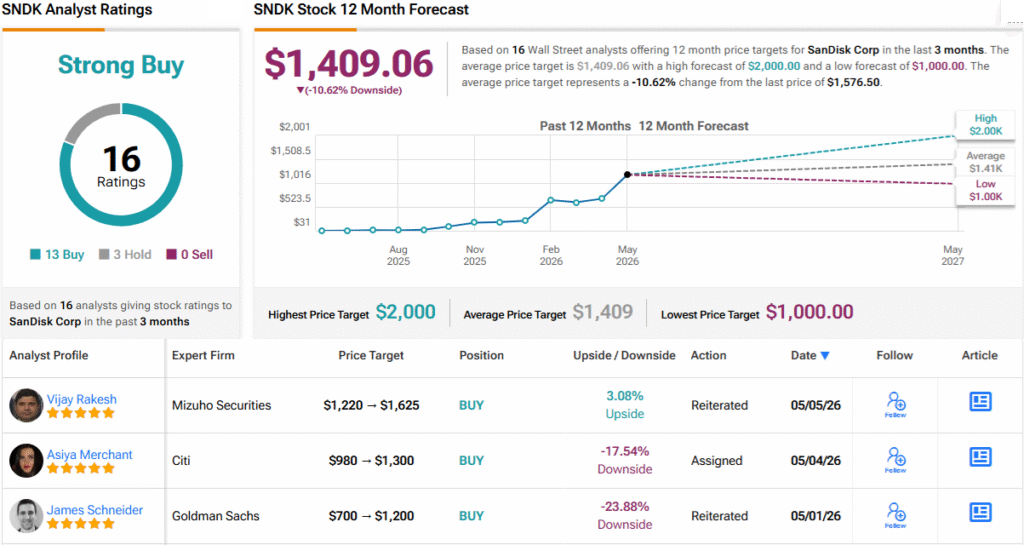
That take, however, doesn’t get any backing from the Street’s analysts. In fact, based on a mix of 13 Buys versus 3 Holds, the shares claim a Strong Buy consensus rating. Yet, the analysts are not fast enough to chase the Fast & Furious SNDK rally, with the average price target of $1,409.06 now implying ~11% downside from current levels. (See SNDK stock forecast)
Disclaimer: The opinions expressed in this article are solely those of the featured investor. The content is intended to be used for informational purposes only. It is very important to do your own analysis before making any investment.