


With interest rates still elevated and volatility creeping back into equities, many income-focused investors are no longer chasing yield alone – they are also looking for stability, shorter durations, and more predictable cash flows. That backdrop has pushed BlackRock’s (BLK) lineup of high-yield iShares ETFs further onto investors’ radar, particularly funds offering yields above 6%.
Meet Samuel – Your Personal Investing Prophet
- Start a conversation with TipRanks’ trusted, data-backed investment intelligence
- Ask Samuel about stocks, your portfolio, or the market and get instant, personalized insights in seconds
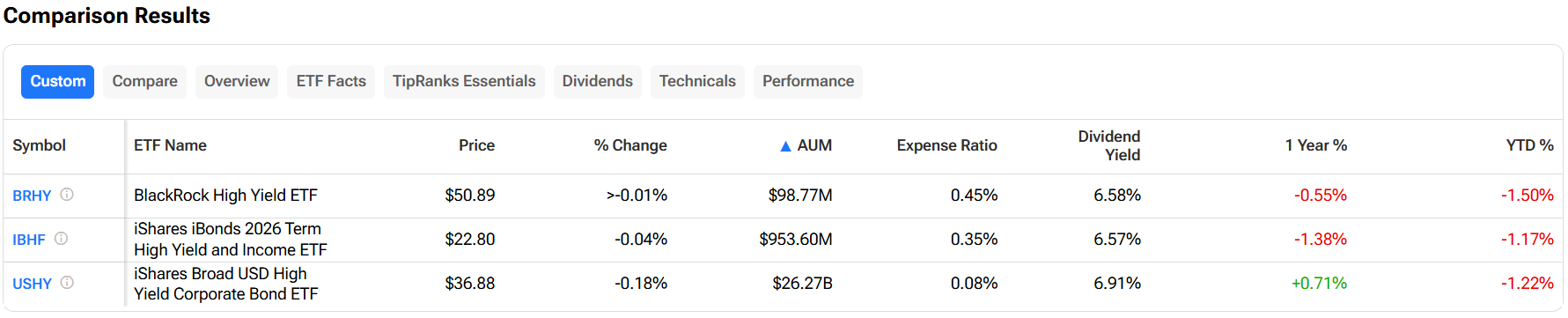
Using TipRanks’ ETF comparison tool, several standouts include BlackRock High Yield ETF (BRHY), iShares iBonds 2029 Term High Yield and Income ETF (IBHI), and iShares Broad USD High Yield Corporate Bond ETF (USHY). Alongside sizable income streams, these ETFs also appeal to investors seeking defined maturity structures, diversified exposure to corporate debt, and potentially lower volatility than many traditional equity income plays.
Let’s break down these BlackRock income ETFs.
BlackRock High Yield ETF (BRHY)
The BlackRock High Yield ETF (BRHY) gives income-focused investors a more hands-on way to approach the junk bond market. Instead of simply following an index, BlackRock’s managers actively select below-investment-grade U.S. corporate bonds they believe can produce stronger risk-adjusted returns while steering clear of weaker issuers. That strategy may appeal to investors looking for sizeable monthly income without relying on individual stock picks.
The ETF holds a wide mix of corporate bonds from different industries, helping limit the impact of weakness from any single issuer or sector. BlackRock says the fund is built to combine income generation with disciplined risk control, an important factor in the high-yield bond market, where volatility can rise during periods of economic uncertainty.
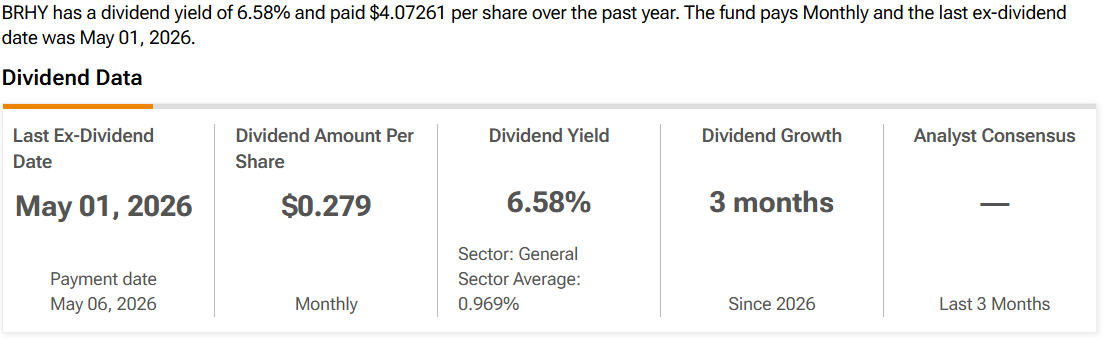
BRHY currently offers a 6.58% dividend yield, far above what investors typically receive from investment-grade bond funds or many broad equity income ETFs. The fund also pays distributions monthly, making it appealing for those seeking recurring income streams. BRHY manages about $99 million in assets and carries a 0.45% expense ratio, which falls in line with many actively managed fixed-income ETFs.
iShares iBonds 2029 Term High Yield and Income ETF (IBHI)
The iShares iBonds 2029 Term High Yield and Income ETF (IBHI) offers investors a different approach to generating income from the high-yield bond market. Rather than holding bonds indefinitely, the ETF is built with a defined maturity structure, giving investors exposure to a portfolio of below-investment-grade corporate bonds scheduled to mature in or around 2029. That setup can appeal to investors who want high monthly income while also having more visibility into the fund’s timeline and interest-rate sensitivity.
IBHI invests in a diversified basket of U.S. dollar-denominated high-yield corporate debt issued by companies from a variety of industries. Its target-maturity structure also helps distinguish it from many traditional bond funds, since the portfolio gradually transitions toward maturity instead of continuously replacing holdings. For those concerned about rate volatility, that framework may provide a more predictable path over time.
IBHI currently offers a 6.74% dividend yield, providing income-focused investors with a much larger payout than many investment-grade bond ETFs or Treasury-focused funds. The ETF also carries a relatively low 0.35% expense ratio, helping investors retain more of the income generated by the portfolio. Over the past year, the fund has gained 1.28%, adding modest price appreciation alongside its monthly distributions.

iShares Broad USD High Yield Corporate Bond ETF (USHY)
The iShares Broad USD High Yield Corporate Bond ETF (USHY) provides broad exposure to the junk bond market through a diversified portfolio of U.S. dollar-denominated corporate debt. Rather than concentrating on a small group of issuers, the fund holds nearly 1,900 bonds from companies operating in sectors such as energy, healthcare, telecom, and consumer services, helping balance risk while still delivering elevated income potential.
Unlike actively managed high-yield bond funds, USHY follows an index-based strategy focused on below-investment-grade corporate bonds. That passive approach helps keep costs low, with the ETF carrying a modest 0.08% expense ratio, well below many competing high-yield funds. The fund also manages about $26.3 billion in assets, reinforcing its position as one of the larger and more established names in the high-yield ETF space.
USHY currently offers a dividend yield of 6.91%, giving income-focused portfolios a much larger payout than many Treasury or investment-grade bond ETFs. The fund also distributes income monthly, making it an appealing option for those seeking recurring cash flow alongside diversified exposure to the corporate credit market.
