


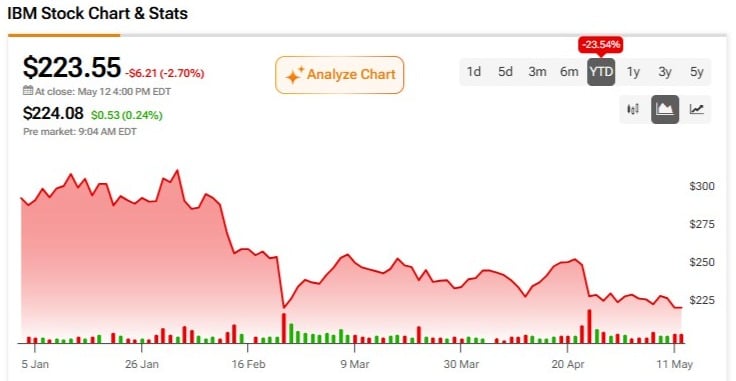
International Business Machines (IBM) is no longer the legacy technology company built around mainframes and services that many investors still associate with the brand. This is one reason I remain bullish on IBM despite the stock being down nearly 22% year-to-date. The company is steadily evolving into a hybrid cloud, artificial intelligence (AI), software, and consulting platform, supported by a growing GenAI backlog, continued Red Hat momentum, and a stronger cash-flow profile.
Meet Samuel – Your Personal Investing Prophet
Double your IBM exposure with Tradr's IBXWhile concerns around slower enterprise spending are understandable, IBM’s recent results suggest demand for AI modernization, automation, and hybrid cloud infrastructure remains healthy. In my view, the market may still be underestimating how much the business has already changed, which is why the recent decline looks more like an opportunity than a warning sign.
Q1 Showed AI Momentum Is Becoming Real
IBM’s first-quarter results were stronger than expected. Revenue rose 6% year-over-year in constant currency to $15.92 billion, ahead of consensus estimates. Software revenue increased 8% in constant currency to $7.1 billion, while Infrastructure revenue rose 12% in constant currency to $3.33 billion. Consulting revenue grew 1% in constant currency to $5.3 billion.
Free cash flow was also strong at $2.22 billion, up 13% year-over-year. IBM maintained its full-year outlook for more than 5% constant-currency revenue growth and free cash flow of $15.7 billion, which could prove conservative if Software and Red Hat continue to improve.
Red Hat Remains a Key Growth Engine
Red Hat is central to IBM’s bull case. In Q1, Red Hat revenue accelerated to 10% constant-currency growth, helped by improving consumption trends. OpenShift is now a $2 billion ARR business, benefiting from containerization, hybrid cloud adoption, and enterprise AI workloads.
This matters because Red Hat provides IBM with a credible platform for hybrid cloud and AI deployments. Enterprises are not moving everything to one public cloud. Many want flexibility across private cloud, public cloud, and on-premise environments. Red Hat’s open-source foundation and IBM’s consulting reach make that combination attractive for large, regulated customers.
IBM now expects Software revenue growth of over 10% in 2026, supported by Red Hat, Automation, Data, and the recently closed Confluent acquisition.
GenAI and Consulting Create a Strong Flywheel
IBM’s AI opportunity is not limited to selling software. The company also has a large consulting arm that can help enterprises implement AI safely and effectively.
That is important because many companies are still struggling to move GenAI from pilots to production. IBM’s pitch is focused on return on investment (ROI), governance, compliance, and integration with existing systems. This is especially relevant for banks, healthcare organizations, governments, and other mission-critical industries.
IBM is also using AI internally. Its IBM Bob agentic development system has reportedly helped developers achieve an average productivity gain of 45%, reduce onboarding time by 70%, increase velocity by around 3x, and improve test coverage by about 40%. These internal productivity gains should support margin expansion and strengthen IBM’s credibility with customers.
Quantum Is an Underappreciated Long-Term Option
IBM’s quantum story remains early, but it could become more important over time. Management expects quantum advantage to be achieved this year and sees quantum computing as a potential $1 trillion value-creation opportunity over the next decade.
IBM has built more than 80 quantum computers and has over 300 partners in its quantum network. The company has also generated more than $1 billion in signings since launching its quantum partnership program.
I would not make quantum the core reason to own IBM today. However, it adds long-term optionality. If AI and quantum increasingly intersect, IBM’s leadership in both areas could become a meaningful strategic advantage.
Valuation Still Looks Reasonable
IBM’s valuation looks attractive relative to its improving fundamentals. The stock trades at a PEG ratio of 0.35, compared with the sector median of near 1. It also trades at a price-to-operating-cash-flow ratio of 15.14, below the sector median of around 19.
That valuation does not look demanding for a company expected to generate $15.7 billion in free cash flow this year, grow Software revenue at a double-digit pace, and benefit from AI, hybrid cloud, Red Hat, and consulting demand.
Wall Street’s View
According to TipRanks, IBM carries a Moderate Buy consensus rating, with 11 Buy, seven Hold, and no Sell ratings. Based on 18 Wall Street analysts, the average price target is $292.63, implying 32.46% upside from the last price of $220.92.

Conclusion
IBM’s Q1 results showed that its turnaround is gaining traction. GenAI demand is building, Red Hat growth is improving, Software is becoming a larger part of the mix, and free cash flow remains strong. While macro uncertainty and consulting softness are risks, I believe IBM’s hybrid cloud and AI positioning remains underappreciated.
Given the pullback, reasonable valuation, strong cash generation, and improving AI-related momentum, I remain bullish on IBM.