



Boeing (BA) is still primarily viewed as a commercial aviation company, but its defense and services businesses are becoming increasingly important to the broader investment story. As governments raise defense spending and airlines extend aircraft life cycles, those segments are helping provide a steadier revenue stream while Boeing works through ongoing delivery and certification challenges.
Meet Samuel – Your Personal Investing Prophet
- Start a conversation with TipRanks’ trusted, data-backed investment intelligence
- Ask Samuel about stocks, your portfolio, or the market and get instant, personalized insights in seconds
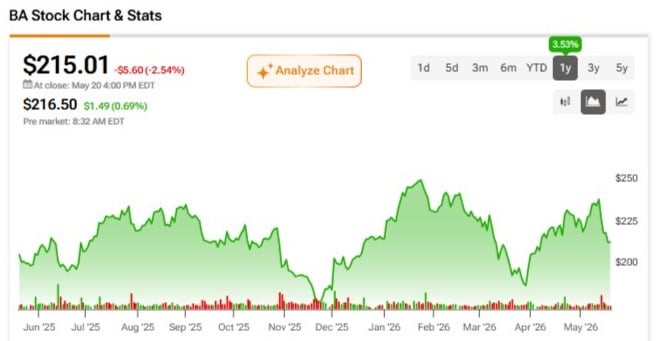
The stock has rallied strongly over the past year as investors gained confidence in the company’s multi-year delivery recovery and relief from past safety and balance-sheet concerns. Even so, Boeing remains highly sensitive to production setbacks and regulatory timelines. The key question is whether its defense and services operations are now large enough to reduce some of that dependence on commercial aviation. That uncertainty is why I remain neutral on BA shares today.
Defense Momentum versus Commercial Volatility
Boeing’s Q1 2026 revenue rose 14% year-over-year to $22.2 billion, led mainly by higher commercial deliveries and stronger defense volumes. Defense, Space & Security (BDS) stood out with revenue of roughly $7.6 billion, up 21% year-over-year, and operating earnings climbed 50% to $233 million, lifting the segment margin to 3.1%.
That improvement is notable when compared with the division’s recent history of recurring program charges and losses, including a full-year 2025 operating loss of about $128 million on roughly $27.2 billion of revenue. The numbers show real progress, but they also highlight that Boeing is still early in its journey of restoring consistently healthy profitability.
The company is no longer in crisis mode, but margins remain thin, and cash flow remains uneven. This leaves only a limited cushion if commercial shocks, certification delays, and regulatory scrutiny re-emerge.
Backlog and Margin Dynamics in Defense
Boeing’s total backlog hit a record of about $695 billion at the end of Q1 2026, with Commercial Airplanes at roughly $576 billion, Defense, Space & Security at around $86 billion, and Global Services near $33 billion. In other words, commercial programs still account for well over 80% of the dollar backlog, while defense accounts for a little more than 12%, and services account for the rest.
Over the past year, the defense backlog has grown meaningfully, helped by new orders from the U.S., even though a recent deal with China didn’t go as planned. Nonetheless, this mix underscores that Boeing’s long-term cash-flow power still hinges on restoring safe, consistent, high-volume deliveries in major commercial programs, including the delayed 777X.
The combined defense and services backlog is now large enough to smooth the revenue profile if commercial deliveries stumble for a few quarters, especially given that a considerable portion is tied to long-dated government contracts. However, because those contracts typically carry lower margins than a fully ramped commercial narrow-body production line, they limit how much of the earnings shortfall they can feasibly offset in a severe commercial slowdown.
Fundamental Analysis and Valuation Context
Boeing’s record backlog of about $695 billion underscores a robust multi-year revenue pipeline. However, most of the near-term value realization depends on converting that backlog into profitable, timely deliveries rather than simply adding more orders to an already full book.
Boeing faces severe structural pressures, with a debt-to-equity ratio of 788.53% and a negative interest coverage ratio of -1.95. Despite this, Boeing’s EV/EBITDA of 28.40x commands a significant premium over the historical aerospace sector average of roughly 16x. Rather than signaling fundamental strength, this multiple is driven by an artificially depressed EBITDA denominator, indicating that market valuation relies on a long-term turnaround narrative rather than on current operational performance and tight liquidity.
Does Boeing Deserve a Defense-Style Re-Rating?
Boeing Defense, Space & Security’s (BDS) revenue growth of 21% in Q1 2026 exceeds the low-to-mid-single-digit expansion typically expected from pure-play defense names like Lockheed Martin (LMT) and Northrop Grumman (NOC). This emphasizes that Boeing is still in a catch-up phase from past disruptions, rather than cruising at a steady state.
However, the quality of those earnings remains lower than leading defense peers because program-specific charges and fixed-price contracts have kept margins well below the double-digit levels that investors reward with premium multiples. As long as BDS margins linger in the low single-digits, the possibility for a full defense-style re-rating is limited.
The strategic backdrop is supportive. Multi-year U.S. and allied spending plans, modernization in fighters and tankers, and demand for advanced training and space systems all point to a robust pipeline for Boeing’s platforms. Yet there may be competition on the horizon, with a potential SpaceX IPO in a few months, which could divide investor attention across the space and defense ecosystem.
What Is the Market’s View?
On TipRanks, BA has a Strong Buy consensus rating. Based on 16 Wall Street analysts’ ratings over the past three months, the breakdown is 15 Buys, one Hold, and zero Sells. The average 12-month BA price target on TipRanks is $274.14, implying a 27.5% upside from the last price of $215.01.

The highest price target is $298.00, while the lowest is $250.00. Broader data from TipRanks also assigns BA a neutral Smart Score of 7, with positive analyst sentiment.
Final Thoughts
Boeing’s Defense, Space & Security segment enhances the quality and durability of its earnings and backlog. Still, at current valuation levels, it is more of a partial buffer than a full shield against commercial manufacturing and regulatory disruptions.
For investors, that means treating defense as an important stabilizer within a still-complex recovery story rather than a standalone reason to chase the stock higher. A balanced view would arguably identify the long-term upside entrenched in Boeing’s backlog, while demanding consistent progress on margins before assigning a defense-style premium.