


Alphabet (GOOGL) is spending enormous amounts of money to expand its artificial intelligence (AI) infrastructure. Not all investors are comfortable with it. The company has repositioned itself as ‘AI-first,’ building large-scale data centers, networking, and custom Tensor Processing Units (TPUs) to support surging demand for AI workloads and data analytics.
Meet Samuel – Your Personal Investing Prophet
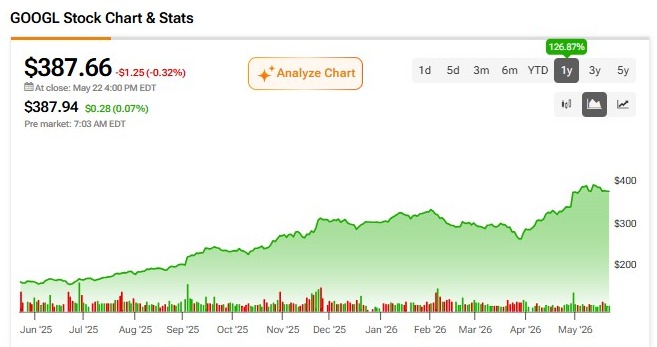
AMZO: built for a short position on AMZNAfter a strong run over the last two years, Alphabet’s stock has cooled relatively as investors reassess management’s aggressive 2026 capex guidance. This has led to a tug-of-war between investors who see capex as pivotal to an AI moat and those who focus on near-term free cash flow expansion. I think the market may be focusing too heavily on the short-term cost.
Alphabet still has one of the strongest balance sheets in big tech, generating most of its revenue from Search, YouTube, and the Google network. Google Cloud continues to gain momentum, and the company remains deeply embedded in some of the most important layers of the AI ecosystem. In my view, the infrastructure spending is less a warning sign and more an attempt to secure a stronger long-term competitive position. That is why I remain bullish on GOOGL today.
AI Infrastructure Spending Is Demand-Backed
Alphabet’s Q1 2026 capex reached about $35.7 billion, with the majority directed toward technical infrastructure to support AI workloads across the company’s portfolio, like the proposed data center in Montgomery. Management has guided to roughly $180 billion to $190 billion in capex for fiscal 2026, almost twice last year’s.
The company is not building this capacity in the dark. Rather, it is leaning into a large and rapidly growing backlog of AI-driven Cloud and enterprise contracts, which gives Alphabet a considerable cash-generation base to fund these projects while keeping leverage manageable. Yet not every AI expense is welcome, as Google DeepMind workers have raised concerns about AI weapons in deals with the U.S. Department of Defense.
Some analysts worry that Alphabet’s free cash flow in 2026 could compress or even turn negative temporarily as depreciation and AI capex weigh on cash generation. While this is a valid sentiment, it is worth mentioning that Alphabet has navigated similar investment cycles before. A notable instance is during the mobile and YouTube expansion eras, when it still achieved higher margins as assets were fully utilized and monetized.
Growth and Margin Still Support the Thesis
Alphabet’s Q1 2026 results provide important context for evaluating the capex ramp. The company’s revenue grew around 22% year-over-year to $109.9 billion, net income increased 81% year-over-year to $62.6 billion, while earnings per share (EPS) of roughly $5.11 significantly outpaced expectations.
Google Services stood out, generating $89.6 billion, up 16% year-over-year, driven by stronger Search, YouTube, and subscription trends. Also, Google Cloud surpassed $20 billion in revenue, growing 63% year-over-year. The operating margin expanded to about 36%, indicating that demand is outpacing the cost base.
This operating leverage is essential when thinking about capex. Since Alphabet earned over $400 billion in annual revenue, improving its operating margin by just 1% would generate enough additional funds to offset the costs of building its new data centers. The early evidence from Q1 2026 suggests that AI-driven pricing power in Google Cloud and higher-value workloads in both Cloud and Services can help sustain that margin trajectory even as capex ramps.
Why Scale and Custom Silicon Matter for the AI Moat?
The case for Alphabet’s AI moat argument rests on more than just aggressive spending. Instead, it lies in its vertically integrated stack that combines proprietary data, custom silicon, AI-optimized data, and global distribution channels through Search, Android, and Workspace. This integration should allow Alphabet to train and serve AI models more efficiently than rivals that rely heavily on third-party hardware.
However, the competitive landscape is intense. Other hyperscalers like Amazon (AMZN), Microsoft (MSFT), and Meta (META) are also pouring billions of dollars into AI infrastructure, and open-source models are reducing performance gaps in some use cases. For Alphabet, the differentiator will likely be how deeply it can integrate Gemini into everyday workflows and how effectively it can translate that into premium pricing power, longer-term contracts, and lower churn across productivity tools.
Some major Wall Street firms, like Morgan Stanley (MS), are bullish on Alphabet. Still, a vital metric may be return on invested capital in AI infrastructure over a three- to five-year horizon. If Google Cloud continues to grow at over 50% annually and AI features improve engagement across the company’s core ad products, the current spending wave would translate into high incremental returns, justifying Alphabet’s aggressive capex.
Fundamental Analysis and Valuation Context
Alphabet combines a robust balance sheet with operational efficiency and a healthy premium. Its current ratio is 2.01, while its debt-to-equity ratio is 18.90%, and its EV/EBITDA is 21.23. Its financial stability enables management to deploy capital at highly lucrative rates, evidenced by a return on equity (ROE) of 32% and return on invested capital (ROIC) of 21.82%.
Despite this fundamental strength, the market is underpricing the company. Alphabet’s PE ratio is roughly 29.1x. While this sits slightly above its own historical trailing averages, it represents a remarkable relative discount within the broader mega-cap technology and interactive media landscapes. When stacked against peers like Microsoft (MSFT), Apple (AAPL), or Amazon (AMZN) — which frequently command multiples north of 32x to 40x — Alphabet offers arguably the most discounted exposure to baseline AI infrastructure monetization among the tech titans.
Meanwhile, its PEG ratio of 1.45 suggests investors are paying a fair price for the company’s massive long-term growth potential. Furthermore, a balanced EV/FCF ratio of 28.50 highlights that despite heavy capex to build out its AI infrastructure and secure market dominance, Alphabet’s core business continues to convert revenue into free cash flow with exceptional efficiency.
What Is the Market’s View?
On TipRanks, GOOGL has a Strong Buy consensus rating. Based on 32 Wall Street analysts’ ratings over the past three months, the breakdown is 27 Buys, five Holds, and zero Sells. The average 12-month GOOGL price target on TipRanks is $428.06, implying a 10.42% upside from the last price of $387.66.

The highest price target is $515.00, while the lowest is $349.94. Broader data on TipRanks also assigns GOOGL an outperform Smart Score of 10, emphasizing that quantitative and qualitative signals line up in the stock’s favor.
Final Thoughts
The story of Alphabet’s AI-driven capex has two sides to it. On the one hand, it compresses near-term free cash flow and raises the bar for returns. On the other hand, it underpins a credible path to a deeper AI moat and stronger long-term economics.
With revenue growth accelerating, margins expanding, and TipRanks data pointing to a Strong Buy consensus, the balance of evidence supports a bullish stance on the stock despite temporary pressure on free cash flow.